
April 17, 2026
Volume 04 - Issue 15

This week I’m loving
This week’s love goes out to Ash Maurya for his reminder to be aware of our assumptions. It begins with the simple statement:
Every startup is a bundle of assumptions.
And this is true.
But it is also true that every project is a bundle of assumptions. That’s why in every project charter I write, there’s a whole section devoted to Assumptions.
Ash recommends a thorough practice, not unlike risk identification, to identify assumptions. He shows how this can be done using a Lean Canvas.
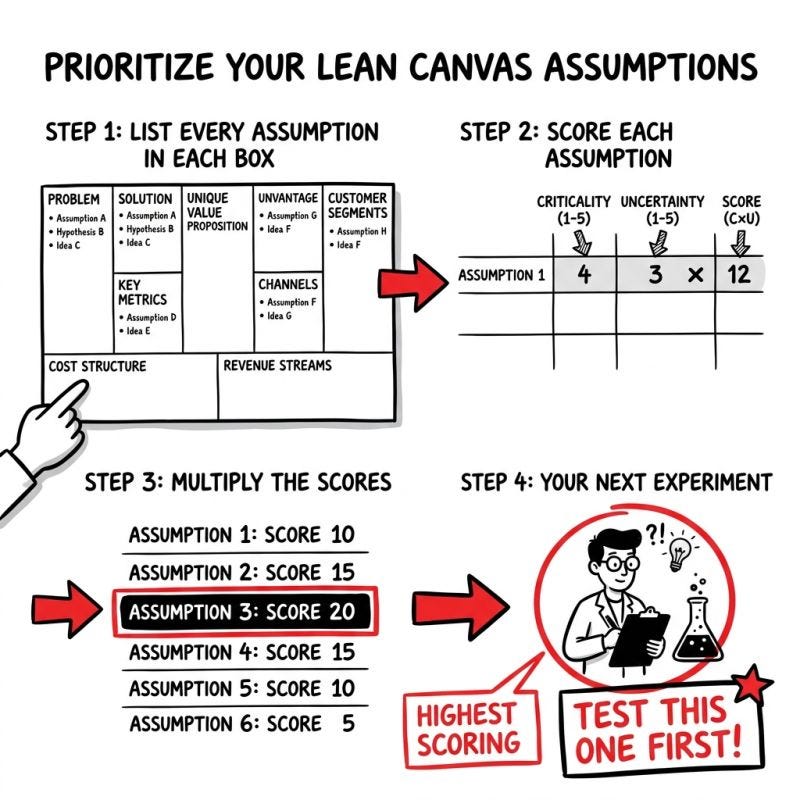
Image credit: Ash Maurya - LinkedIn
This tool also works for projects and the process can be applied in the same way.
Many project teams struggle to figure out the right order to deliver things in. I find, in fact, that teams will address this by delivering the easiest things first even though the hard things are what take the most time. This is your number one reason for a sliding schedule BTW! Ash shares my concern in his context. He advises ranking assumptions by risk (specifically how critical the assumption is and how much evidence there is that the assumption is valid). Test the assumptions that have high criticality and low evidence first (a.k.a. build and deliver these first).
Now here’s a key: every assumption’s rank should be based on how critical it is to the business model. But that also means you need to know and understand the business model before you can evaluate. I like the business case to be summarized in a project charter as a reminder of this and to provide context for subsequent project reporting and evaluation.
How often do you think about assumptions in your project practice?
From the Practice
This week I’m highlighting a great little article from Adriana Girdler on the roles that project managers play that go beyond the title.
She labels these roles as:
Diplomat
Negotiator
Psychologist
Cheerleader
Firefighter
Detective
Wearing your Diplomat hat you need to read the room - understand stakeholder motivations, and tailor communication accordingly. This is about managing relationships. As a generalist PM lean into your big picture and empathy skills to successfully fulfill this role.
…the goal isn’t to “win.” It’s to move the project forward while maintaining trust and alignment.
Many project professionals think the Negotiator role is just about conflict. Adriana points out that negotiation starts long before the moment of conflict - at the very beginning of the project. As a negotiator you inject clarity and neutrality into challenging conversations that shape priorities. As a generalist PM lean into your collaborative problem solving and strong communication skills to successfully fulfill this role.
…if a negotiation feels uncomfortable, that doesn’t mean you’re doing it wrong.
… negotiating protects the project boundaries.
Wearing a Psychologist hat might not be your first instinct as a project manager but the ability to see what is going on under the surface of interactions and assertions you observe is one of the most underrated skills in project management. Use curiosity to test your observations, deploy active listening to deepen understanding, and then use your emotional intelligence to clarify what’s really going on. As a generalist PM your empathy and strong communication skills are your strengths in this role.
This part of your project manager role isn’t always comfortable. You will have some tough conversations.
…which is what keeps projects moving when everyone is feeling pressured.
Intentionally shaping the energy and momentum of the team is a key component of successful project Cheerleadership. When the team is getting bogged down, pump up the energy with praise, belief, and a little patience. When the team is overconfident, ground everyone in priorities and requirements to ensure the right outcomes are delivered. Your most important quality as a generalist PM in this role is your ability to adapt. You’ll navigate highs and lows and the unpredictability of Tuckman’s stages of group development before you reach the finish line.
Because even the most well-built project plan depends on the people executing it – and how they feel about the work matters.
The Firefighter role isn’t about being reactive or dramatic. Instead, it is being steady, composed, and prepared because you know projects won’t go as planned. Build risk awareness and cultivate contingency thinking from the start. Your generalist superpower when wearing this hat is your flexibility.
Being the firefighter means staying calm when others come to you with urgency. It means separating emotion from the issues in front of you. You don’t ignore problems that crop up, but you also don’t amplify them by panicking.
Finally, the final role you might need to adopt is that of a Detective. Here you’ll uncover expectations, assumptions, and requirements that aren’t coming to the surface on their own. You are asking the right questions at the right time. As a generalist PM you are tapping into your ability to recognize patterns and see through complexity that might be masking these details.
…you investigate. You ask open-ended questions and listen carefully. You look for root causes rather than just paying attention to symptoms.
Because the reality is, missed deadlines and quality issues rarely come out of nowhere. There’s usually a signal of misalignment or unclear expectations, and a good detective spots those signals early.
As you finish reading this I hope you are nodding your head in alignment with this. But I also want to acknowledge that the heavy load many of us feel in delivering successful projects comes from the context switching of these roles, often not acknowledged by others in our organization and often which we ignore or forget ourselves.
If, on the other hand, you are a junior PM, cultivating your skill at wearing these hats is what takes you to a senior level and beyond the PMBOK®.
The path to better visibility in your organization is being seen as competently wearing these hats overtly to improve project delivery.
An interesting read
This week’s interesting read is a thought-provoking idea from the Experience Institute that I think every generalist PM needs to get immediately acquainted with.
Lately I’ve been thinking about what it means to operate in this age of discontinuity.
In 1969, Peter Drucker wrote a book titled “The Age of Discontinuity” which discussed the rise and demise of large organizations alongside the massive shift from manual work to knowledge work. Today we are seeing another shift of a similar scale from knowledge work to “perceptual work” or the “co-pilot era”.
With this disruption, the article argues we are seeing the need for a new capability emerge: collective intelligence.
Collective intelligence isn’t better collaboration. Collaboration is additive: you bring the right people into the room, everyone covers their lane, and the output is roughly the sum of what they knew when they walked in. That’s useful. It’s also not enough.
Collective intelligence is generative. It’s what happens when people with genuinely different mental models, different assumptions about how the world works, are in productive friction with each other. The interaction produces something none of them could have produced alone. You’re not pooling knowledge. You’re creating something new from the collision between perspectives.
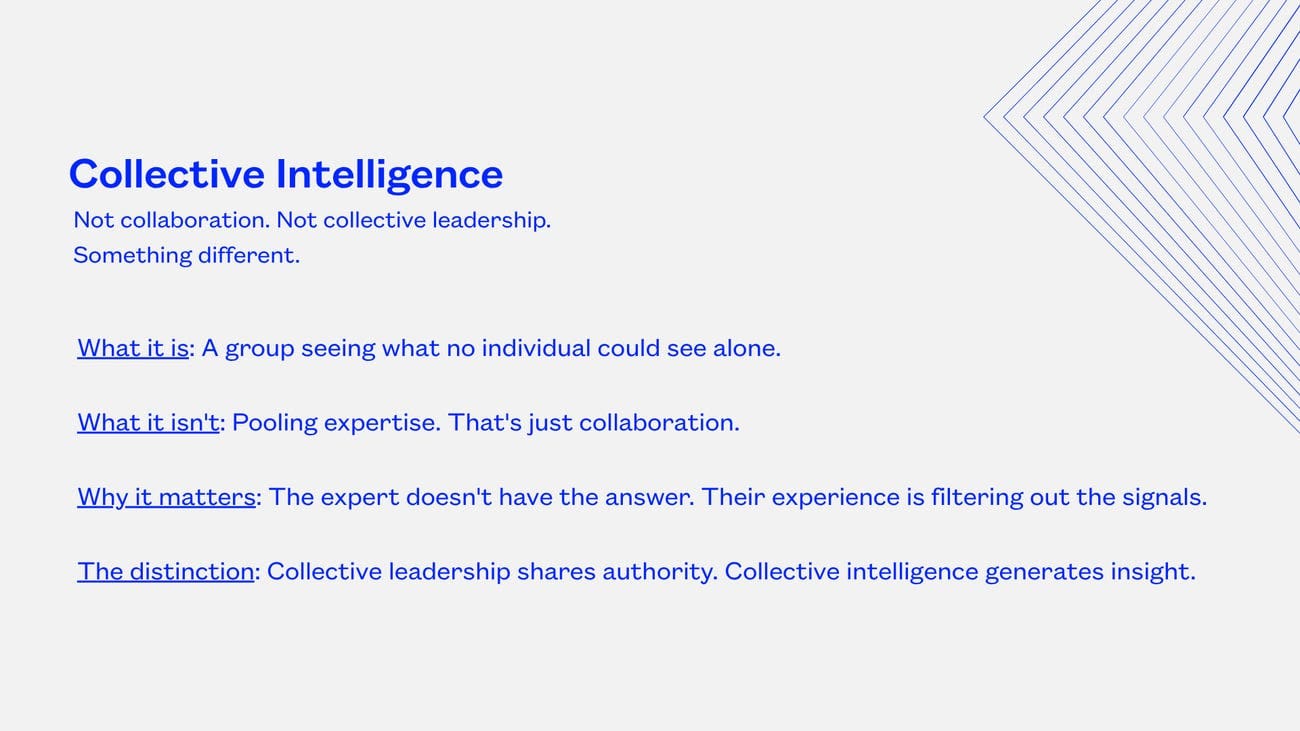
Image credit: Wednesday Words newsletter by the Experience Institute
As generalist PMs, one of our most important curiosities is our interest in early adoption. Our flexible mindset and willingness to adapt make us capable of early adoption ahead of many of our colleagues.
Pause here for a moment and reflect: what would happen if you started managing your team for collective intelligence instead of collaboration? What friction are you feeling that you might move past if you asked a different question? Generalist PMs are quick to move into problem-solving mode. What are you quietly filtering out when you do this? What value would this have if you let the collisions happen?
I think this might be the key to what generalists offer in this new age of discontinuity. We offer a willingness to recognize our own patterns and temporarily suspend them in favor of experimentation and in favor of collective intelligence.
A tip
More and more, project managers are being engaged in strategy. And yet, not much is being done to help us cultivate strategic competencies.
Worry no more. Alex Smith has a great summary of the essentials in his Strategy Cheatsheet.
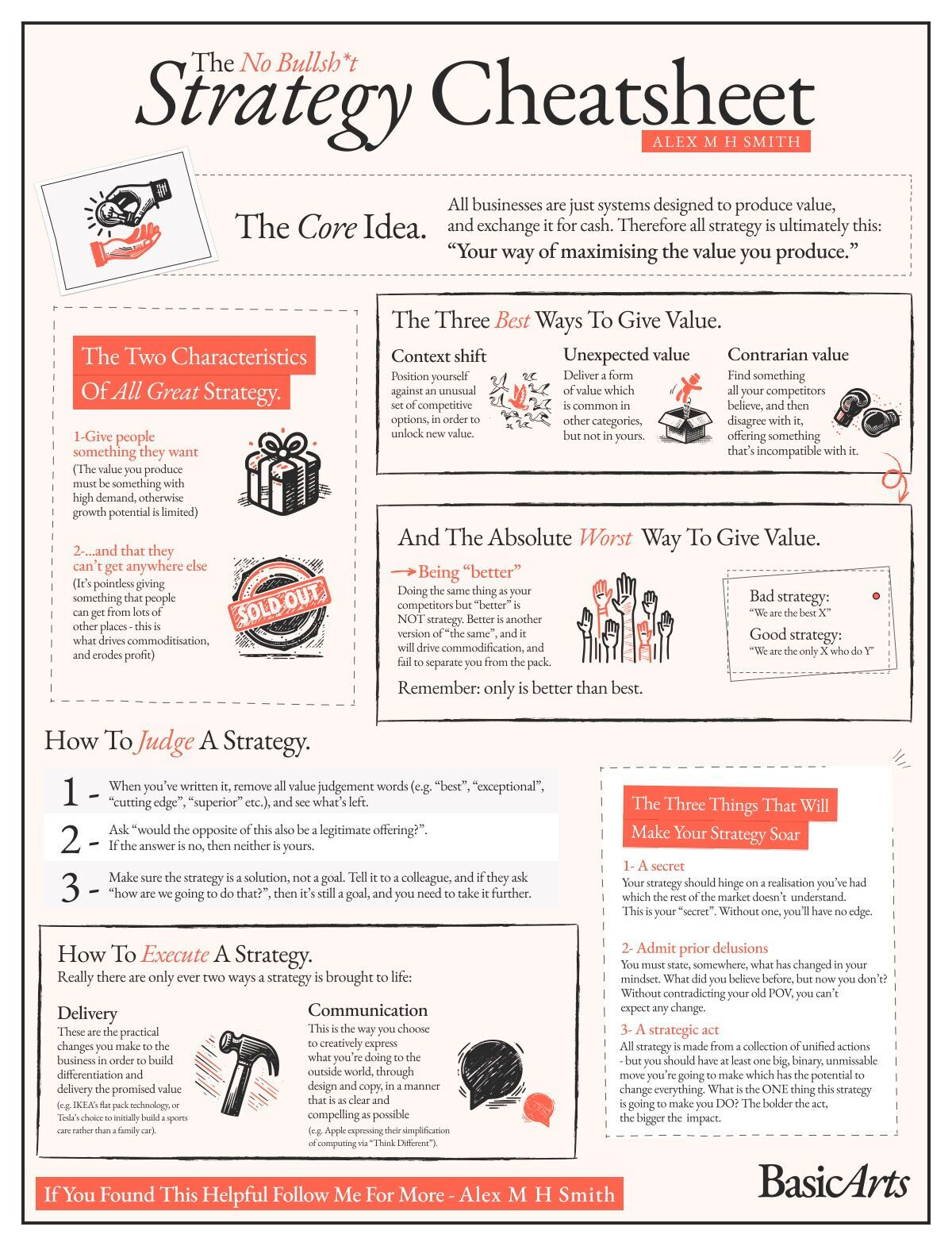
Image credit: Alex M H Smith - LinkedIn
A lesson
This week’s lesson comes to us from Victoria Christensen who writes the Project Management Lab. In her recent post, Victoria writes about her experience chasing perfection and how this awakened perspective on the importance of usefulness rather than perfection. I’ve met many a project manager who struggled with perfectionism. But the truth is that worrying about how the work reflects on you is the most detrimental manifestation of your ego there is. That’s an internal focus when the duties of a project manager are external - to the team.
Usefulness is external.
When you prioritize being useful, you build trust. And trust is a more valuable currency than a flawless color-coded spreadsheet.
Where are you striving to be perfect, when you should be striving to be useful?