
August 7, 2026
Volume 04 - Issue 31

This week I’m loving
This week’s love goes out to Rob Lambert for his reminder about the difference between being lost and exploring. I think every generalist I’ve ever met has coped with feelings of being lost at various times in their career. How powerful to instead think of these moments that lack clarity as moments of exploration rather than a failed destination.
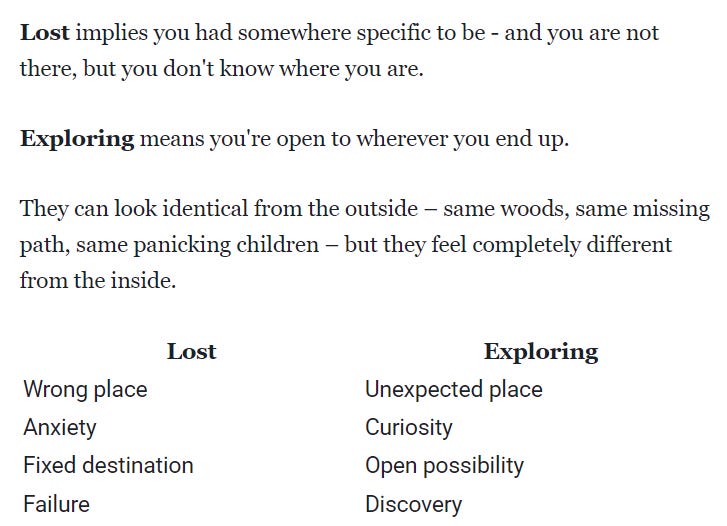
Image credit: Rob Lambert - Meeting Notes - Aug 2, 2026
The specialist pathway is linear with an obvious destination and it is tempting to think that we should expect this path for everyone. Truthfully, some of the best experiences happen when we meander off the path, and the generalist career journey is one such exploration.
It's difficult to discover anything new if you insist on arriving exactly where you planned. Looking back, I suspect I've spent a lot of my life confusing exploration for being lost.
From the Practice
This week we look at an article that’s written from a product lens, but I bet applies just as much to projects. Specifically, when someone builds you a schedule or roadmap instead of allowing you to do so. And especially if that someone is above you in organizational hierarchy.
These days, the most common source of this is, your favorite AI friend put to work by someone who lacks the project details and your shrewd experience on the difference between a schedule on paper and a schedule in real time.
What I loved about the article is it presents a practical approach to addressing this while keeping your career intact. 3 questions, each of which will be valuable to a project just as much as they are valuable in a product context. I have one slight modification to the first question: What customer evidence is behind this deadline?
Customer evidence behind a deadline reveals the real pain point and need that are driving the desired outcome. If customer evidence behind a deadline can’t be disclosed, then likely the deadline is internal. Perhaps padding financial performance or unblocking later activities. This can help you formulate a valuable discussion around unrealistic timelines.
The questions about areas of struggle reveals the parts of the project the executive doesn’t understand. This can help you drive clarity on what the project will actually take and discuss revisions in a context of what is possible and relevant.
And the last question uncovers assumptions. Apart from needing to be carefully observed to ensure they are true, uncovering assumptions allows us to manage expectations.
Have you had this scenario happen yet in your practice?
How did you handle it?
An interesting read
This week’s interesting read caught my eye because of its valuable question: what’s one belief you had to unlearn in order to keep growing?
Richard Branson shares his answer in the article.
But I wanted you all to also take note: progression into leading vs managing is a journey of growth and often it requires us to unlearn what we know or relearn what we know in a new context. A huge limitation to personal and professional growth is the attachment to what we know as being the reason for our value. Richard reminds us that our value isn’t in what we know, but in how we bring people together around knowledge.
A tip
A great reminder from Eric Partaker on the difference between Culture and Values.
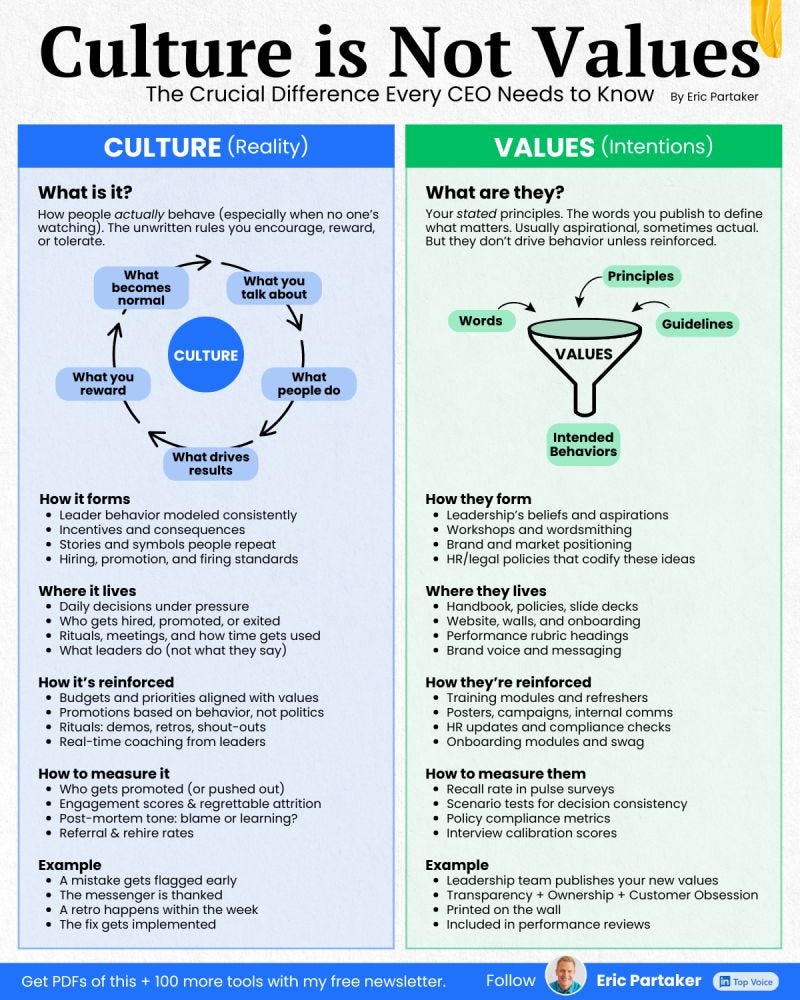
Image credit: Eric Partaker - LinkedIn
A lesson
This week’s lesson comes to us from Cassie Gruber who wrote a reflection piece about organizational behavior patterns and their impact on results/outcomes. This is a great read, but I want to dig a little deeper on the relevance for project managers.
The real differentiator between the best project managers and the rest of project managers isn’t skills, or personality, or experience. It’s speed. Or maybe we should say impatience.
It’s an utter dislike of tolerating things that aren’t working (or maybe things we should call bad behavior). It’s setting the expectation that the team will perform at top bar and relentlessly holding them to that.
But importantly, as Cassie points out, it is preventing the future outcomes of current behavior.
Project managers are an insurance policy against organizational drift.
Because we see it, when others can’t.
Because we won’t tolerate it, when other’s do.
And because, we’ve been trained to respond tactically with corrective action before we’re too far off course.
If you’ve ever wondered how to describe your value to an organization, this article should give you some insights.
Enjoy!