
July 17, 2026
Volume 04 - Issue 28

This week I’m loving
One of the most common questions I get from generalist project managers, is where can I go next? Project management on its own can feel like a dead-end career path as a generalist and after some time a bit “been there, done that”.
One of the neat things about a generalist PM career is that you have acquired a whole host of skills that are outside the box of project management. And now, you can check out how those might fit into a career after project management using CareerMatch, a tool developed by a Generalist World member.
Not surprisingly I ended up here:
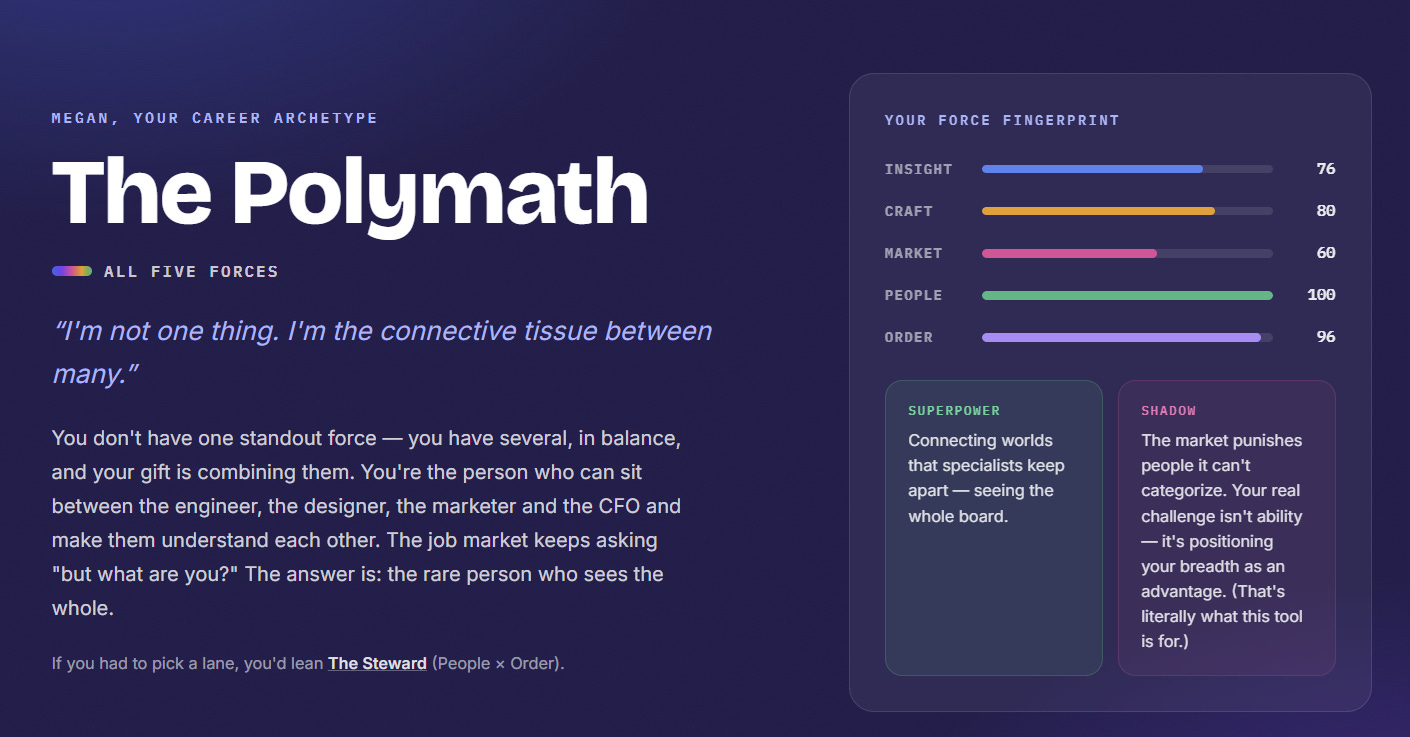
Image credit: CareerMatch results
With a 100% match to roles such as Project Manager, General Manager, and Strategy Analyst and a 97% match to Chief Operations Officer or Fractional CxO which is what I do now.
Where did you end up? Any surprises?
From the Practice
This week’s From the Practice segment is a mash-up between a couple of sources of advice.
First, Margareth Fabíola S. Carneiro reminds us that stakeholder management is a skill that can be learned and practiced, not just a natural talent for “being good with people”.
Practitioners who handle it well don't wing it. They understand every stakeholder: their needs, their expectations, their power, their interest in the project. They also do something less obvious: they build a model of how each stakeholder actually decides things. Data-driven? Relationship-driven? Risk-averse? Once you know that, you stop pitching the same argument to everyone and start pitching the argument that lands.
This idea of building a model about a stakeholder’s motivations engages an ability many of us don’t consciously tap into that David Epstein discussed in an intriguing essay this week: prediction.
Specifically our brain’s ability to quickly group information into a “chunk” that allows for fast predictions driven partly by prior exposures.
Some of the earliest work on chunking was done in chess in the 1940s. Chess players of different ability levels were shown chessboards for a few seconds, and then asked to recreate the arrangement of pieces. Grandmasters could reconstruct boards after seeing them for only three seconds, so they appeared to have miraculous memories. Decades later, that experiment was repeated, but this time the participants were also given boards with random arrangements of pieces. The grandmasters lost their advantage in that scenario. They didn’t have photographic memories; they had learned to chunk groups of pieces so they could understand a board instantly.
This is what differentiates an experienced project manager from a junior project manager when it comes to stakeholder management. We’ve got a larger library of exposures and more “chunks” to work from, making our predictions more accurate and giving us strong anticipatory skills to head off stakeholder challenges before they arise.
And, if we take this concept a little further, this is really what gives great project managers and in particular generalist project managers their “edge”. Your experience across organizations has taught you a set of “chunks” — patterns of behavior in organizations that help you predict what will happen before the organization knows. Just like an elite athlete can see things on the field his teammates can’t, you can see things in the organization that others will only recognize when it is too late to prevent the goal.
So if you are seeking to “level-up” as a project manager or want to more consciously refine your craft, I think the quickest path is to make the process of acquiring “chunks” more conscious. Cultivate awareness of the small predictions you make every day. Observe which ones are right and which ones are wrong. These lessons are available to everyone, but engaging with them is the key to career progression.
An interesting read
This week’s interesting read is a Harvard Business Review article on team dynamics. Specifically, it discusses 4 common traps that may derail leaders and teams.
Certainty - this is a failure to recognize that every situation is interpreted through the lens of perspective and therefore uncertain
Inconsistency - this is a mismatch between what we say and how we behave
Emotional reactivity - this is the challenge that people may respond differently and with different levels of intensity to the same event
Justification - this is the tendency to try to explain or rationalize our behavior instead of critiquing it
The article identifies six leadership actions that can help to avoid these traps.
Self-awareness
Maintaining respect
Activating honesty
Seeking the full story
Fostering collaboration
Consistent action
Difference is unavoidable. In today’s organizations, it is also one of the greatest sources of untapped value. The leaders who succeed will not be those who eliminate tension or create perfect harmony. They will be those who recognize the hidden landmines that accompany human difference—and develop the skills to navigate them with awareness, humility, and intention.
A tip
Building SOPs (Standard Operating Procedures) for your organization and not sure where they should live? Here’s some great tips about how to create useful documentation in Google Docs from Dani Bruflodt at Thyme is Honey.
A lesson
This week’s lesson comes to us from a product context but is useful for project managers as well. The topic? Measuring ≠ Learning. I’m seeing this a lot lately in consulting work - the downside to the ease with which AI tools can surface data is people are building dashboards they are very proud of containing a lot of metrics that don’t help.
There are thousands of things you can measure, but measuring for measurement's sake isn't helpful. It needs to drive decisions.
With the frequent use of iterative delivery a lot of project teams are collecting metrics that should support learning around whether a release or launch of one iteration is meeting success criteria and in turn this should support revisions to the subsequent iteration. However, in reality we see this a lot more rarely than you might think.
Good metrics don't start with the solution or the measurement. They start with understanding the problem.
Examine your metrics and categorize them into two buckets:
Vanity metrics - tell you what has already happened and make you feel good
Actionable metrics - tell you what to do next
Measuring the vanity metrics is usually easy. Measuring the actionable metrics is usually hard.
Test metrics you propose to use with four questions:
What are we trying to learn from this metric?
What change will be made as a result?
What threshold triggers action?
If we stopped looking at this metric what consequence would we see?
Good metrics will have answers to all 4 questions.