
July 24, 2026
Volume 04 - Issue 29

This week I’m loving
Something I’ve rarely seen discussion of that every project manager should be on top of is the comparative cost of AI vs human tasks.
That’s why this week’s love goes out to Mateo Cellini for a very illuminating piece on exactly this topic.
Intelligence is getting radically cheaper. Useful work is not.
Here is the calculation seducing every boardroom right now: a model completes in seconds a task that takes an employee thirty minutes. The API bill is twelve cents. The employee costs €30 an hour. Multiply across a department and the business case appears to write itself.
But twelve cents buys an output. It does not buy a completed, correct, accountable piece of work. And the gap between those two things, the output and the finished job, is where the entire economics of AI at work actually lives.
Any project manager reading this should immediately recognize that an output is only half the story. We don’t need to focus on the output, we need to focus on the outcome. An output that doesn’t generate the outcome can be quite costly.
Pricing AI labour by token cost is the equivalent of pricing human labour by the electricity that runs the laptop. It is a real cost. It is also the smallest one on the invoice.
The unit that matters is not the cost per response. It is the cost per acceptable outcome.
Facts:
models show diminishing returns translating into a cost curve that scales quickly for higher accuracy
the cost of generating an answer (“intelligence”) is the only one falling rapidly
the ability to trust the answer (“reliability”) is a cost very few are tracking
the ability to repeat the output at scale (“organization”) is the cost that is missing from your pilot but present in your implementation
Bottom line: as execution becomes abundant, the limiting constraint is human biology — the “verification bandwidth”.
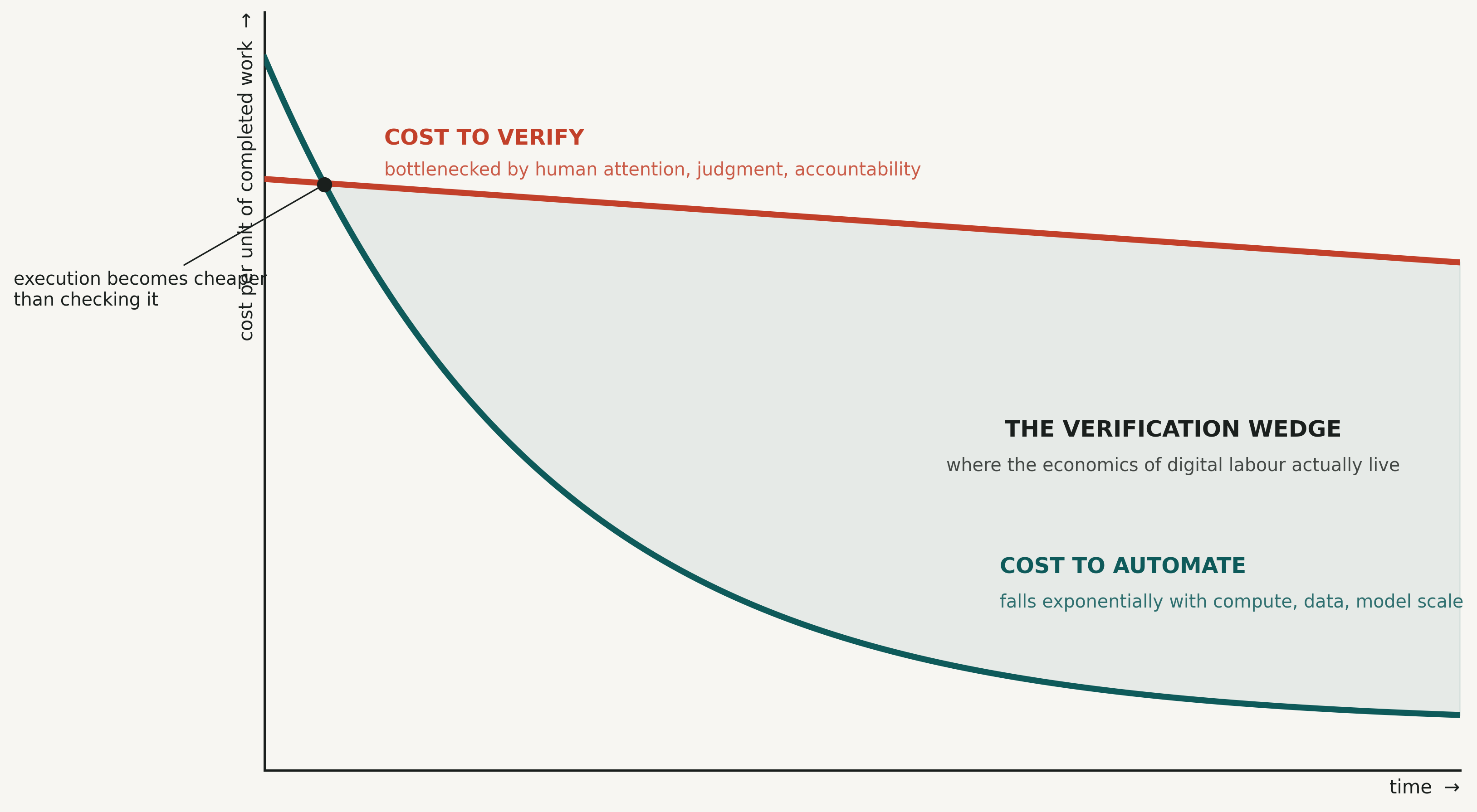
Image credit: Work3 - The Future of Work - Mateo Cellini
The wedge between the curves is where the economics of AI integration actually lie and it is a cost structure that isn’t going away. Examining this wedge is going to become a critical skill for project managers being tasked with AI implementations.
From the Practice
How many of you are managing quality consciously in your projects?
One of my favorite variants of the triple constraint visualizes quality at the center.
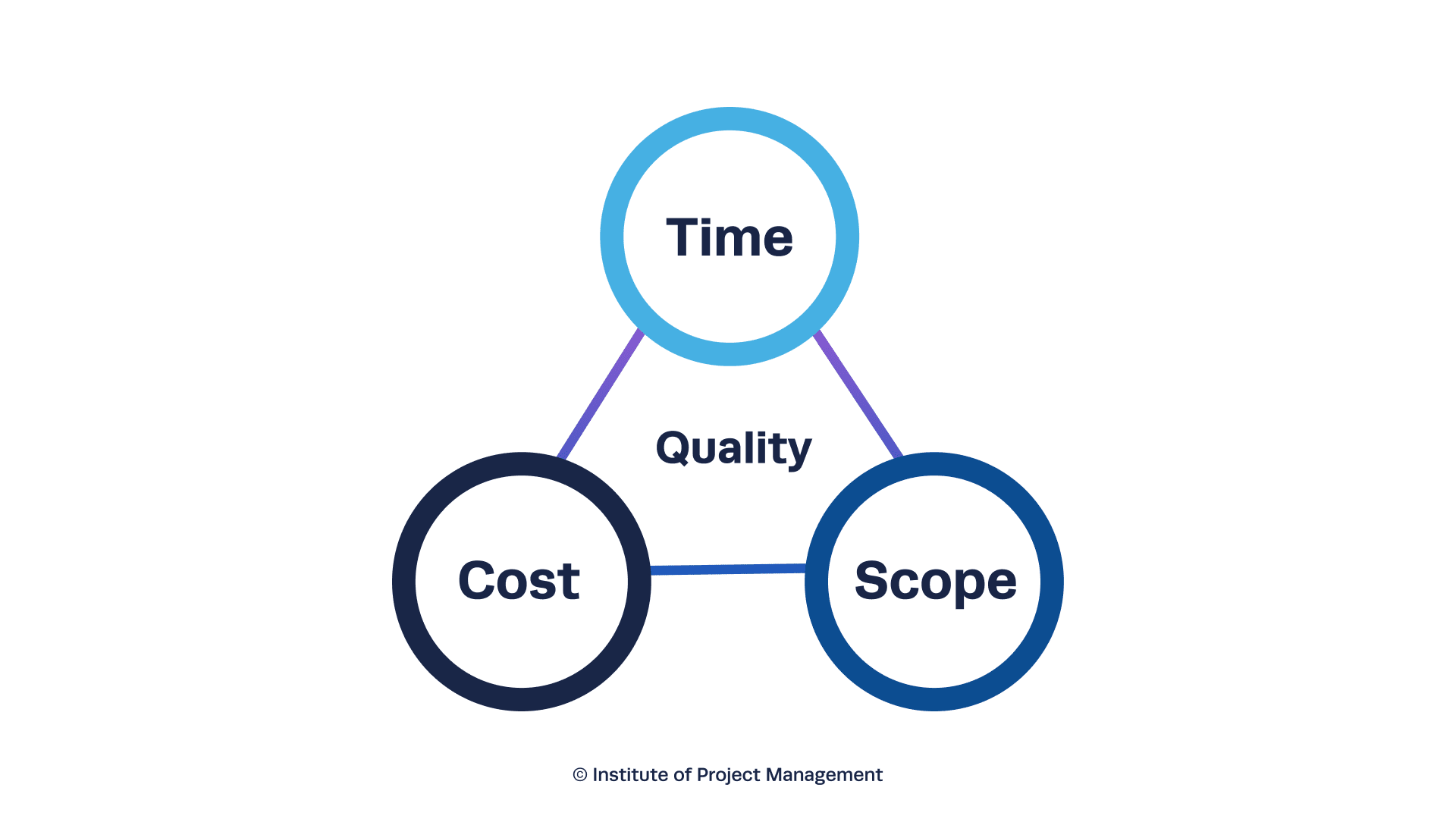
Image credit: Institute of Project Management
This depiction allows recognition of the fact that delivering on time, within scope, and within budget may be unsuccessful if poor quality is achieved.
But only about 30% of organizations understand where quality costs their organization according to the American Society for Quality (2025 Quality Excellence Report).
So in this week’s From the Practice segment I’m highlighting a great primer on project quality from Adriana Girdler. This comprehensive write-up covers why quality is important, the three pillars of quality management, common organizational impacts of quality issues, and the steps you can take to manage quality more carefully.
If what we’ve discussd here is resonating, I highly recommend this read.
An interesting read
If you’ve ever been curious to learn more about Lean’s origins at Toyota, this week’s interesting read is for you.
Here’s five reasons to read this article:
Actual Toyota knowledge from first-hand integration into the system. This includes an authentic diagram describing the system.
A real understanding of how Kanban is part of a broader system, not an isolated tool.
The importance of standardization as a component of a successful lean implementation.
The importance of capable, flexible, and motivated humans in the successful lean implementation.
And finally, the relationship of all the components of the system to its success. A vision that it is not something to be cherry-picked from, but something to be implemented with careful attention.
A tip
Good stuff from the PMI newsletter this week for all of you feeling the pressure to learn AI and quickly getting exhausted by it.
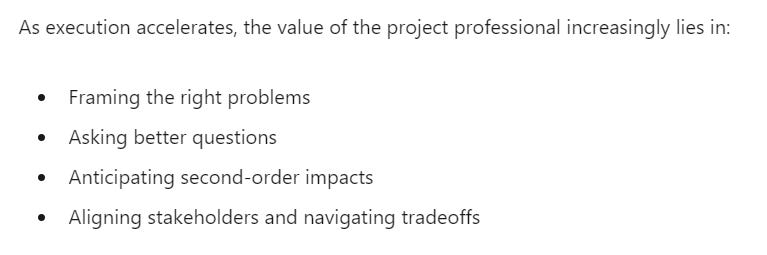
Image credit: The PMI Newsletter - July 23, 2026
First: recognize that not all skills stay relevant. Instead, they fit into three categories: perishable skills; durable skills; and enduring skills.
Think of AI learning like building a balanced plate. You need some things that help you right away, some that sustain you over time and some that support your long-term growth. The same is true for skills.
The plan:
For perishable skills: Build fluency with current AI tools
For durable skills: Apply AI through a methodology
For enduring skills: Strengthen the human skills that compound
A lesson
This week’s lesson comes to us from Ant Murphy and while written from a product lens, has important parallels for most project managers.
Strategy requires you to find points of leverage and therefore knowing these concepts are key to making smarter choices.
Positioning - do you understand how your product, project, organization is perceived by the customer? It’s only valuable if it is perceived that way.
Flywheel - importantly, this is a self-reinforcing system around the outcome and really - the key that supports a great idea becoming a business. A value delivery system gets the deliverable into the hands of the customer. A flywheel ensures that act makes the next delivery easier.
Growth - how are you amplifying your audience?
Retention - what makes a customer stay with you after the first purchase?
Per Unit Costs - importantly, how can you optimize these and how will you reduce them over time?
Intangible Assets - do you know what else matters beyond the deliverable and outcome themselves? These are your intangibles and stewarding them is just as important as the deliverable and outcome.
Competitor Response - how will your competitors respond to your positioning? How can you make that as difficult for them as possible?
Diversification - if you are wildly successful at reaching your market, what’s next?
The key to a great strategy isn’t having all of these components, but, how you combine them matters. Ant’s article discusses a few possible combinations for reference.
Happy reading - and let us know what your key takeaway was from this article!