
June 12, 2026
Volume 04 - Issue 23

This week I’m loving
This week I saw a fantastic post I just had to share with you that perfectly sums up why generalists excel at strategy:
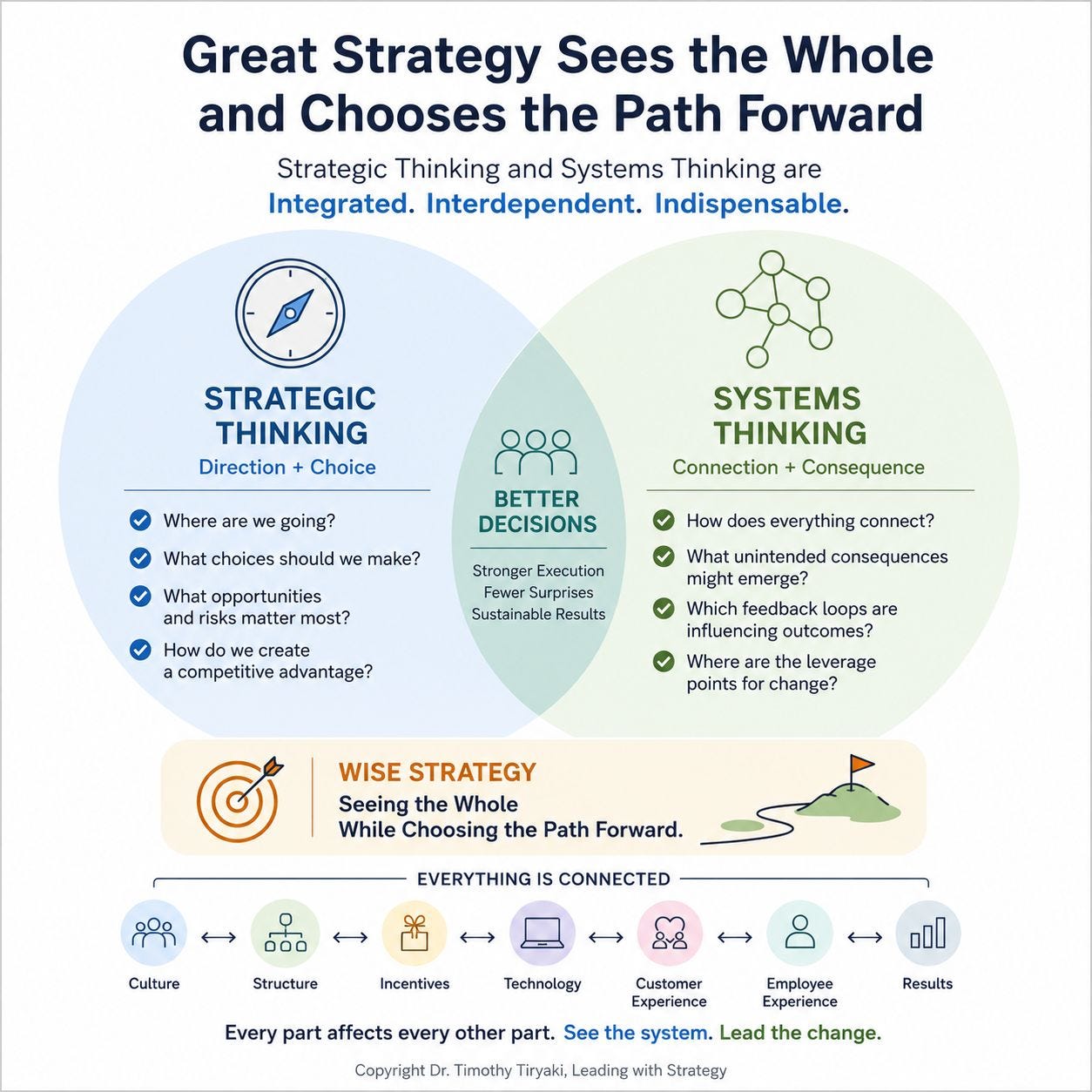
Image credit: Timothy Timur Tiryaki - LinkedIn
Strategy isn’t just the ability to think strategically. It is the ability to use that skill in a systems context. Timothy rightly points out that this is really a combination of strategic thinking and systems thinking.
Strategic Thinking without Systems Thinking can become simplistic.
Systems Thinking without Strategic Thinking can become analysis without direction.
Let’s be honest for a moment: how many organizations have you worked for where one of the above symptoms was present?
I know, me too!
Timothy goes on to describe an effective strategist as:
Someone who can see patterns
Someone who can see connections, and especially maybe connections others haven’t thought of or seen themselves
Those are the key traits of many generalists. And this is why strategy is such a sweet spot for us.
And if you’ve been struggling to get people to see what you can see, maybe try explaining the “whole” that you can see to them. It might just be that what seems obvious to you, isn’t at all visible from their perspective.
From the Practice
Last week saw the release of the Project Management Institute’s Standard for Artificial Intelligence in Portfolio, Program, and Project Management; a 297 page “shared framework” for applying AI responsibly across portfolios, programs, and projects. PMI members can access a digital edition included with their membership here.
Image credit: Project Management Institute(PMI)
I read this document with great intrigue as my hunch is that it would reveal a gap in project management guidance that is not insignificant in my opinion. While PMBOK® helps a project manager carry out projects with consistency, and can be used to support an organization repeating this across multiple project managers, it doesn’t really teach organizations how to have a project management system. It is true that there is a PMO guide for that, but the evolution toward a PMO has a step before one exists where just the project management system exists.
Indeed I was not disappointed:
“This standard applies to various organizations…” defines the document’s approach in Section 1.3. Then Section 1.4 turns around with “this standard is intended for PPPM practitioners…” as the document’s audience gets defined. Meanwhile Section 1.4 goes on to say that the document does “cover organizational governance” and “can enable” PPPM practitioners to govern AI in project management but overall the rest of the read doesn’t really add clarity to this gap.
More than AI is a tool for project managers, it is a tool that is most effective if implemented in sensible places by an organization, but herein lies the conundrum I’m worried about. If the organization has no guidance on how their project management system should, or does, operate, then how is a standard for how AI should be implemented within that helpful? We are still stuck at individual project manager implementations of best practices and this will leave glaring gaps in implementation let alone effectiveness.
There is an “or” scenario. That scenario is where a project manager takes charge of an organization-wide implementation of best practices. It is also true that some project managers may be effective at this. But that would be entirely through their natural talents, not something they are taught. It is something that is also still contributing to project manager exits from many organizations.
One thing that is novel about this standard is the performance domains that are recommended strongly link the project manager with organizational strategy. For example “Executing Strategic AI Goals” emphasizes the connection of AI projects to business strategy and prioritization. This isn’t a bad goal - but are project managers really getting this opportunity? I know we want them to be, but is that an organizational reality? Similarly “Defining the Scope for AI” implies a project manager is involved in these discussions. Don’t get me wrong, they should be, but the gap between what should be happening and what is happening is vast.
There are a couple of gems.
On page 209, in an area describing how to motivate knowledge workers, Autonomy Mastery and Purpose (a concept first made popular by Daniel Pink) appears. I believe this is the first time PMI has formally included this in guidance documentation although I have been teaching it to agile project management students for years. Design thinking also notably appears on page 211.
Finally, one last concern that I have is about exposure. We already know that project managers are often made to be a “fall guy” when a project isn’t successful and very often this has nothing to do with the actual competency of the project manager. In the discussion of Ethics and Legal considerations on page 238 the guide claims “Artificial intelligence systems’ accuracy and decision-making capabilities are remarkable when implemented in PPPM; however, these systems are not infallible.”
Firstly I’m not sure I would characterize accuracy of any AI tools I have used yet as “remarkable”. The rates of hallucination are far higher than I would like to see to characterize a system as such. But this section glosses over an important professional conflict that I am hopeful I am not alone in feeling: we have a duty to take ownership for the decisions we make or fail to make, the actions we take or fail to take, and the resulting consequences. Most professional project managers I know take this duty seriously, but it is also heavily in conflict with outsourcing decision-making to AI and I’m not sure a “Human-in-the-Loop” is enough protection with the level of transparency most AI tools on the market offer these days.
I like to look where I’m leaping, I don’t leap without looking. There’s a small part of me is worried that this standard is going to encourage more of the latter than the former.
How about you? Is this a helpful reference? Or a bigger conundrum?
An interesting read
This week’s interesting read comes in Fish Food for Thought from Mike Fisher and is one of the most unique takes on organizational dysfunction I’ve seen! I’ll intrigue you with this quote and leave the rest of this brilliance for you to dive into.
A Boeing 737 has roughly two hundred controls, switches, and indicators in its cockpit. A child’s tricycle has three points of input: two pedals and a handlebar. Both work because the controls match the complexity of what they’re trying to do. Put the tricycle’s three controls on a 737 and you’d kill everyone on board. Put the 737’s instrumentation on the tricycle and even most adults wouldn’t be able to ride it.
This sounds obvious until you realize most companies are doing some version of the second mistake every day. They’re trying to fly a 737 with tricycle controls.
A tip
I was thinking today as I was working with a coaching client about a challenge that many leaders, including project leaders, face which is, what do you do to stretch yourself further when you are leading across multiple teams? If your usual mode of leading is high touch this causes pain pretty quickly. But a lot of people making a transition from usually leading one team (like many project managers) to leading several teams for the first time, that’s been their default? And nobody really suggests how to do it differently.
Here’s what I recommend.
Look for patterns. What’s happening on the new team that you recognize from the old team. Are there commonalities in work or ways of working? What do you already know as a result?
Start building your leadership system. It’s not just a day-to-day or week-to-week routine anymore. What activities leverage you the best to benefit your teams? How can you make these available and valuable as much as they are needed? What can you stop doing or change to create space for what will be most valuable?
Get better at questioning. You won’t have time to know everything. You have to shift out of being a knowledge holder to seeking clarity when it isn’t apparent. Often those moments where you aren’t clear are also not clear for others and asking a great question can empower the solve for both you and the team members.
What can you template? Don’t just fly by the seat of your pants. Intentionally shape interactions by carrying out your interactions the same way. Use a consistent agenda and framework for 1:1s; have a way you take notes and use it for every meeting; organize your to-dos in one space.
Harmonize where possible. As you see patterns and commonalities, how can you influence these toward consistency. Consistency simplifies operations and ensures you can spend your energy on things that matter instead of context switching.
A lesson
Many generalist PMs are working in smaller companies or startup environments because it gives great latitude so I try to provide content that helps this audience in particular when I can. Today’s lesson from Krista Mollion outlines key antipatterns that show up as a company tries to grow and what to do instead. I can vouch that I’ve seen all of these happen and love how practical the lessons are for anyone wanting to change course.
Strategic thinking without systems thinking is how you end up with beautiful plans that ignore second-order effects. The real tell is what happens at the edges of a decision... where it touches another domain, another team, another incentive structure. That's where generalists earn their keep. The ability to see around corners in organizations comes from having worked in enough corners to know they connect. Most pure strategists have never sat in the coordination layer long enough to understand what they're optimizing against.