
June 26, 2026
Volume 04 - Issue 25

This week I’m loving
One of the most magical things found in science is recombination. As a biochemist, nothing was more fascinating than housing an exercise in recombination. Now a living, breathing, walking product of the magical genetic shuffling exists. He has my fingers and toes but his Dad’s physique. My hair color, his Dad’s and grandad’s eyes, and a skin tone somewhere in between mine and my husband’s. Scientists have studied this phenomenon for decades and still the exact reasons why chromosomes hug each other and gently exchange pieces of themselves eludes us.
This week, this beautiful concept was used to illustrate what it means to be a generalist, and I loved it. Because honestly, let’s face it, all of us are a little bit mystified as to how exactly our brains put the things they assemble together. Daniel Horton writes about a concept first coined by Maria Popova: combinatorial creativity.
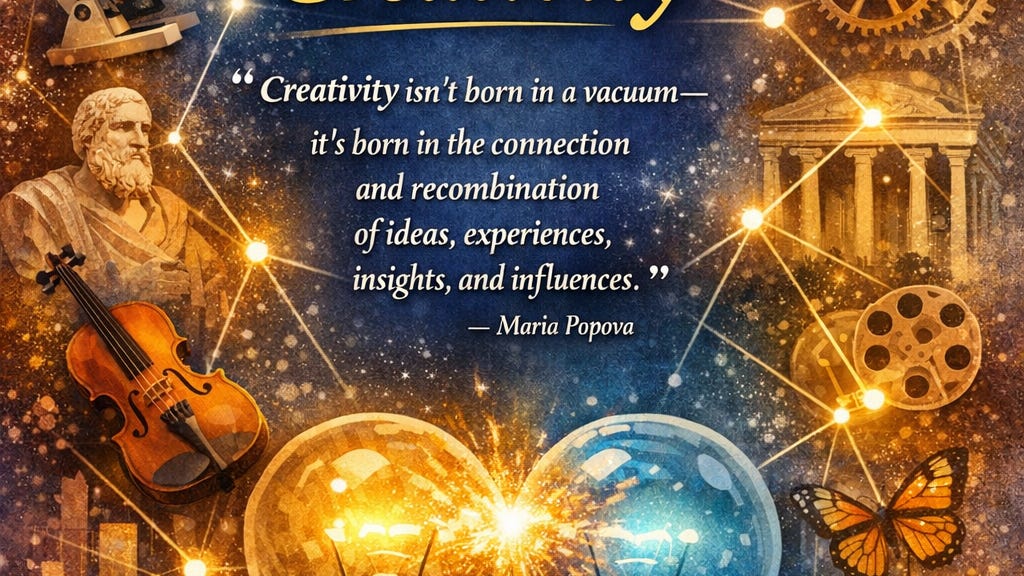
Image credit: Chat GPT Generated Image published by Daniel Horton
And there it was, the beauty of recombination in the magical context of generalism.
It is not about invention from nothing. It is about recombination. Synthesis. Seeing how two ideas from two different fields might lean toward each other, if placed side by side.
This challenges the myth that originality is a “lightning bolt” of divine inspiration.
Like genetic variation isn’t usually introduced by a random spontaneous mutation, but by a steadily executed process of careful genetic shuffling — the generalist genious isn’t in a piercing idea, but in the quiet study of seemingly disconnected patterns until synergies emerge.
In a world obsessed with originality, the real magic is in intelligent remixing.
Popova’s choice of the term combinatorial is especially interesting. In operations this refers to selecting an optimal solution from a fixed array of possibilities. It implies that our brains are potentially trying all the possible combinations looking for the best one. But I suspect, that we are far more likely to be recombinant. A slightly magical assembly of discrete insights into a novel picture. Daniel suggests our core skills that drive this magical outcome and pegs them as critical in this next era. I don’t disagree with his stance.
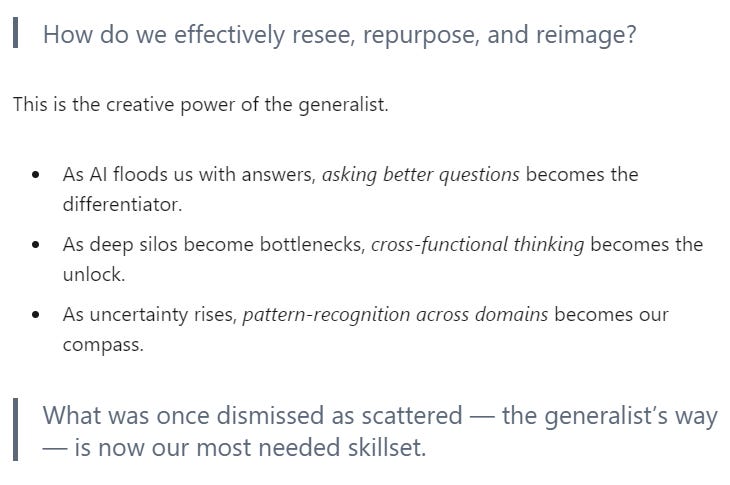
Image credit: Daniel Horton - Combinatorial Creativity and the Rise of the Generalist
From the Practice
There’s been a lot of talk about where to apply AI in project management and this week we shine a spotlight on some interesting advice from Barry O’Reilly about judgement.
This is the paradox of the AI era.
Information is abundant. Judgment is scarce.
Machines can process, store, summarize, and compute at a scale no human can match. They can recall years of conversations, synthesize thousands of documents, detect patterns, and generate options in seconds. But they still do not know what matters in your company, with your customers, at this moment, given your strategy, constraints, values, and risk appetite.
That responsibility still sits with leaders.
The constraint in modern organizations is no longer access to information. It is judgment under pressure.
Barry goes on to propose that organizations will need both “Human Judgement Systems” and “Technology Judgement Infrastructure” to address this scarcity. This is noteworthy as it is the first intelligent framework I’ve seen that proposes a solution to the problem.
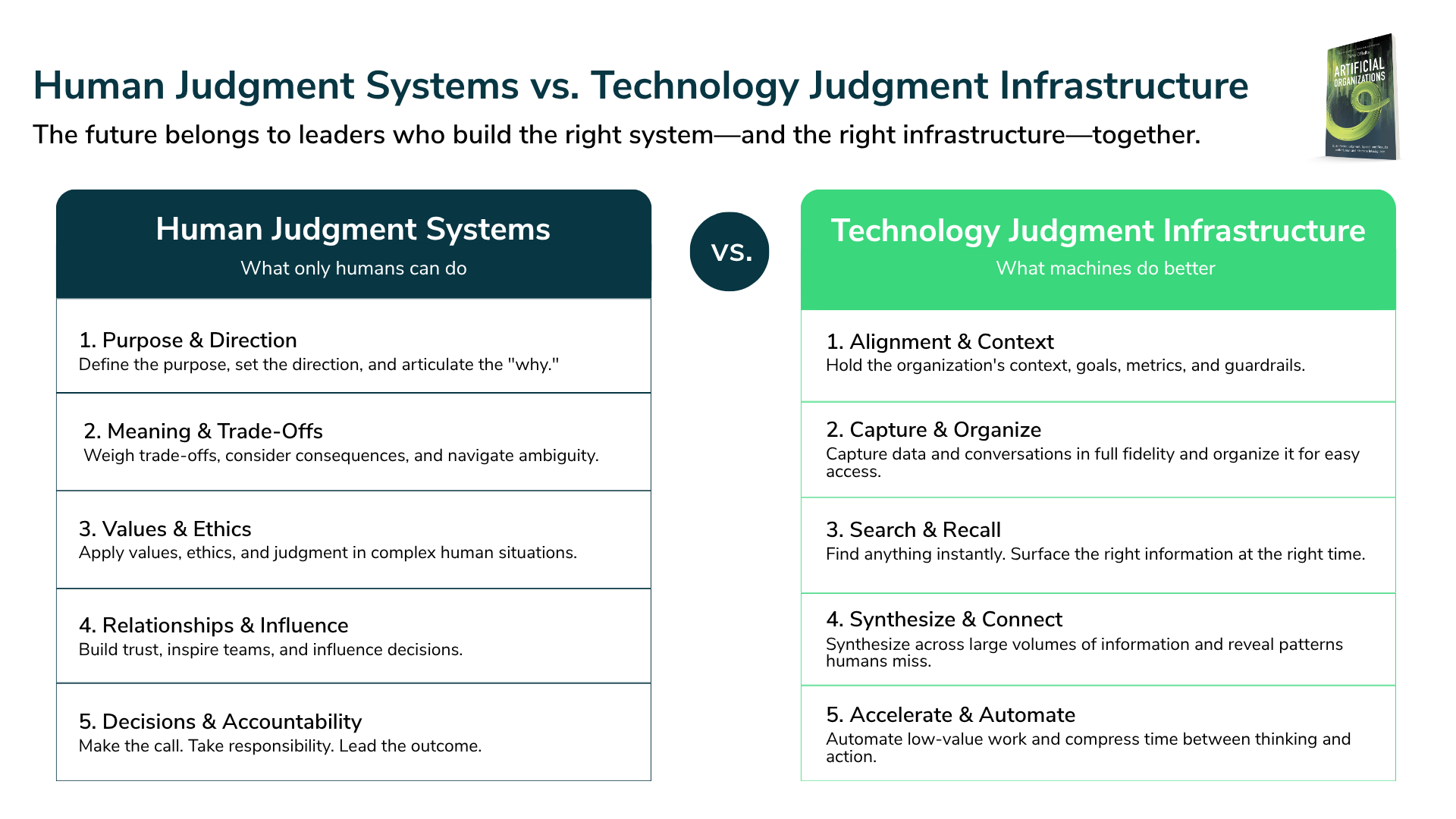
Image credit: barryoreilly.com
A Human Judgment System without technology infrastructure stays trapped in one person’s head. It cannot scale.
Technology Judgment Infrastructure without a human judgment system creates speed without wisdom. It produces more output, more noise, and more confident wrong answers.
The opportunity is to deliberately combine both, so your organization can make better decisions, faster, with greater clarity and confidence.
Project management provides an excellent scaffold for human judgement systems. Barry’s framework provides an excellent pattern to hold your current AI tools against to evaluate if they are really providing technology judgement infrastructure or simply noise. And a great place to pressure test this infrastructure is inside project decision-making, where the combination of human judgement and technology judgement is easily undertaken by professionals who should be prepared for it. That’s where your AI transformation should start if you want it to be successful.
An interesting read
This week I read that the middle child is an endangered species. While a few decades ago many families had three or four children, today this is far less common and most households have an only or an oldest and youngest.
Organizations are giving themselves a similar haircut. Dubbed “the Great Flattening” by George Pesansky, the layer between executives and the front lines is evaporating at many of the largest and most successful companies the world has ever seen.
In an interesting article in Fortune Brett Hurt, CEO of Love Conquers Fear proposes that the reason for middle management’s existence in organizational hierarchy was to move information. He suggests that AI is eliminating this reason for existence, replacing scarcity of knowledge with an abundance of it instead.
Margareth Carneiro, PMI Fellow, also wrote this week on this topic with a slightly different take. She alludes to decades of research since the introduction of the Agile Manifesto as self-organizing teams became more common.
Subsequent research began to challenge that assumption. Studies highlighted persistent needs for strategic alignment, resource allocation, and career development, functions that self-organizing teams alone struggled to fulfill. The person everyone had declared redundant turned out to be doing things nobody had thought to measure.
I think the answer lies somewhere in translation. It is true that information and knowledge flows through the middle layer of an organization. But the real secret to project management is the translation that happens in that layer. High-level, big picture thinking, is carefully scoped into executable steps. This isn’t a one shot deal. It’s a constant exercise of listening and shaping, observing and reporting, and then listening again. A constant reframing and reminding to maintain alignment. Alignment complements autonomy, it isn’t a standalone.
Indeed Brett’s article lands on this conclusion with Harvard research to back it up.
What emerged was not the elimination of management but its evolution toward managers who translate organizational purpose into the behavior of autonomous systems while holding the human values that govern both.
If that isn’t a project manager, I don’t know what is described. The middle child isn’t going extinct. But some of them will be changing roles and skillsets if they stick around.
…that living connection: between purpose at the center and value at the surface, between machine intelligence and the irreplaceable human judgment that must govern it. Their authority is not positional. It is contextual — grounded in knowledge of team, customer, and moment that no algorithm can hold.
A tip
Came across this great cheatsheet this week around PERT estimating.
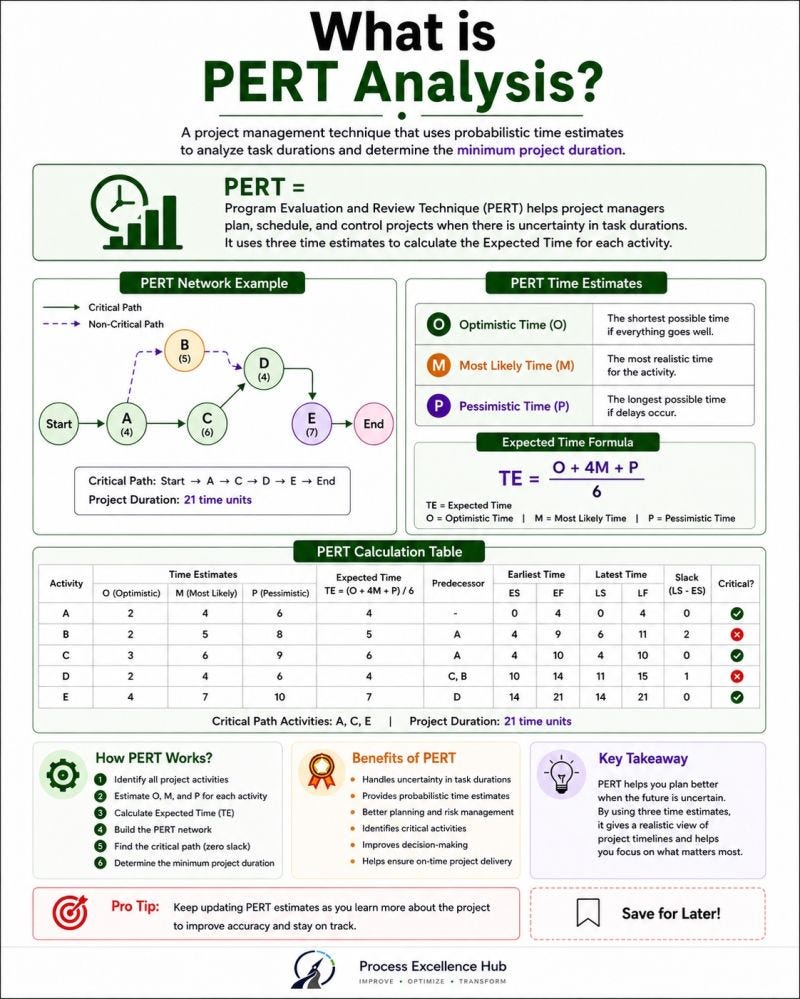
Image credit: Process Excellence Hub
A lesson
Ever been in a room that suddenly seemed to lose its mind?
This week’s lesson from Cassie Gruber reminds us that we should immediately understand this situation to be driven by fear.
Fear is a behavioral signal. It shows up in how people communicate under pressure. In whether they speak first or wait to see which way the wind is blowing. In how they handle mistakes, their own and others’. In whether meetings produce real decisions or the appearance of decisions. In whether accountability is genuine or performative.
These are organizational signals. And like every signal in this series, they tell a story long before traditional metrics reflect it.
Cassie provides some guiding questions that may help you uncover the root causes of fear so that it can be addressed.
Where is fear surfacing on your team, and what did it show up dressed as?