
March 13, 2026
Volume 04 - Issue 10

This week I’m loving thinking
Hey friends! I hope that this week’s newsletter finds you all at the end of a successful week.
Over the past few weeks I’m been pondering an idea and this week I’m being brave and asking you for your thoughts on it.
We’ve got a good little community together around this newsletter and it is my belief that this more than proves that a “generalist PM” is a real archetype in project management.
I know that every company I have worked for has needed a generalist PM exactly at the moment I have worked there.
I’ve heard similar thoughts from those of you I’ve discussed the journey with.
Which leads me to a problem: How do companies that need generalist PMs and the generalist PMs themselves meet each other?
If you’ve got a super great place where you source your roles, let me know here!
And if you don’t, which has been my straw poll so far, I’m curious, would it be helpful to you if there was somewhere to find a perfect match? If so, what would you want or need?
From the Practice
This week’s “From the Practice” is highlighting a recent article from Fola Alabi that provides a cool approach to closing strategy gaps in project management and organizational practices. As we have frequently discussed, generalist PMs bring strong talents to strategic execution that can be grown into a strategic practice over time, but just as for most PMs, we rarely have training specifically targeted at this competency. What I liked about Fola’s approach is it helped to both identify areas where competencies are needed and breaks down what to work on or develop to close the gap. This means that any reader could design their own professional development plan to develop the suggested competencies using pre-existing education existing in the relevant areas.
The framework also recognizes that this is a partnership to cultivate professional competencies alongside organizational capability (something I also advocate for in the area of value delivery).
If you’ve been looking at this gap in your own environment and wondering how to address it, this read is for you. If you check it out, I’d love to hear what you thought!
An interesting read
As project managers we frequently face situations that require us to act in a way that will carry consequences we may not be thrilled about. This week’s interesting read addresses how you can evaluate when are the right moments to stand tall, even when risks arise as a result. I loved this article for providing a simple but effective framework that supports making difficult decisions.
One of the hardest moments as a project manager is when you need to stand up and go against the expected direction. Author Sunita Sah coins a term for this leadership quality that I deeply appreciated: Strategic Defiance.
In my research, I define defiance as “acting in accordance with your true values when there is pressure to do otherwise.” It’s not disobedience for its own sake, but a principled response to misalignment: a quiet refusal to comply when something isn’t right. It looks like questioning a misleading marketing strategy, pushing back on biased promotion practices, or challenging an initiative that crosses a line.
Acting in this manner is an opportunity to:
Build credibility
Earn trust
Demonstrate integrity
Think for long-term survival
Yes, principled resistance carries risk. But so does silence. And over the long arc of a career, the cost of going along with what you know is wrong is almost always greater.
How do you recognize the moments where Strategic Defiance might apply?
You’ll be feeling tension. That nagging in your gut keeping you awake at night as you chew over the scenarios hoping to find something that won’t create discomfort.
It can be tempting to push that feeling to the side, but, instead, naming your discomfort and examining where you feel the tension is an important step on the path to a solution.
Next you examine the potential application of Strategic Defiance using the framework Sunita describes as the “Defiance Compass”.
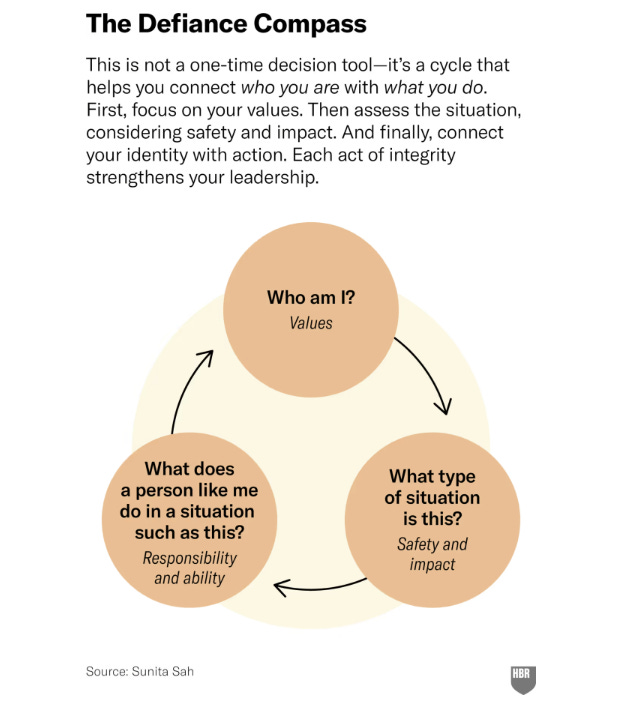
Image credit: Harvard Business Review - Sunita Sah
If, after this evaluation, you’ve made the decision to act, your first step is Escalation. Bring the matter to the attention of relevant stakeholders. Ask for clarity.
Communicate that you may not comply. Give the stakeholders an opportunity to reconsider their position.
And finally, if nothing changes, then take your principled action.
You halt a rollout. You walk away from a deal. You publicly challenge a decision. The tone can be calm or forceful—but the commitment is clear: you will not comply.
Not all acts of Strategic Defiance are loud or large. It is a muscle that you can exercise with small acts where you practice reflecting, using the compass, or resisting without going all the way.
In a business world where pressure to comply is constant and often subtle, the ability to defy—strategically, quietly, repeatedly—is a mark of true leadership. It doesn’t require a platform or grand gestures. It requires clarity. Clarity about who you are. Clarity about what matters. Clarity about the kind of leader you choose to be when the stakes are high, and no one’s watching.
A tip
If you haven’t already registered, I highly recommend signing up to attend PMXPO 2026. This free virtual event hosted by PMI each year is always packed with trend-worthy discussions and knowledgeable speakers. Registering for free allows you to attend live and access on-demand content if you are a PMI member.
Key topics that may be of interest include:
Pulse of the Profession: Leading Project Success in a Complex World
Influencing without Authority
Product Delivery in 6 Steps
Refocusing PMOs on Business Outcomes
Learn more and register here.

Image credit: Project Management Institute
A lesson
This week’s lesson highlight, with several lessons to offer, comes from Hanadi Usman who writes from her practical experience in Canada leading a high profile transformation initiative in Canada. Here are my key words to live by from Hanadi’s reflections.
You don't need consensus. You need clarity about who decides, and a process that moves fast once the decision is made.
Plan enough to start. Adjust as you learn. Build feedback loops that let you course-correct without starting over.
Decision velocity matters as much as decision quality. Build structures that let you decide fast and adjust if you're wrong.
Fast execution requires stronger governance, not weaker governance.
You don't need to approve every decision. You need to see every decision.
Credentials get you the interview. Judgment gets you the outcome.
Strategic defiance is such a useful frame for something most operations and project leaders navigate without a name for it.
This sounds really useful, especially the bit about designing your own development plan from existing resources. So often frameworks just tell you what’s missing without helping you actually close the gap. Does Fola’s approach work better for individual contributors or does it scale to team level too?