
May 15, 2025
Volume 04 - Issue 19

This week I’m loving
This week’s love goes out to Jeroen Kraaijenbrink for a post that maybe every generalist needs now and then as a reminder.
Growth is not a straight line.
It rises, plateaus, and then demands something from you.
Yet we expect a straight line. We think the straight line is what happens for everyone else. We think we are different.
But the reality of how people and organizations actually grow looks nothing like a smooth upward curve.
It rises. It peaks. It plateaus. And then it faces a choice.
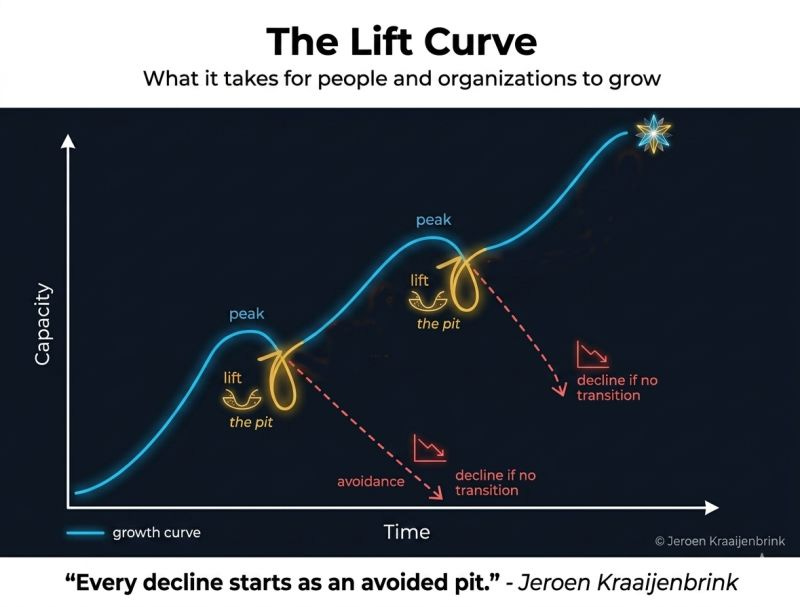
Image credit: Jeroen Kraaijenbrink - LinkedIn
I’ve been in a season of growth for at least the past year, perhaps a tad longer. It has been full of moments that felt like a summit, and moments that felt hard to see the way through. Jeroen’s post reminded me that this is to be expected.
Sometimes, as lifelong learners, it can feel like we have a routine for growth. A pattern we slip into that is comfy. A road we walk that feels familiar even if different, one where the destination is predictable. The truth is, that’s not real growth. It’s just the acquisition of capabilities. This is deceptive as a generalist because it comes easily in many cases.
Real growth requires something different at every peak. It requires going into the pit, into the uncomfortable work of letting go of what worked, facing what needs to change, and building the capacity for the next level from the inside out.
This clarity was helpful to me this week, and I hope it was for you too!
From the Practice
This week’s From the Practice takes a close look at the latest Pulse of the Profession® report which PMI (Project Management Institute) released on International PMO Day (May 12, 2026) and available free to all PMI members.
The topic? Complexity. Specifically the impact of complexity on projects and their success.
The report is worth a read overall, but here’s some really key insights I noticed:
If you are frustrated that the complexity you see and want to talk about isn’t resonating with your senior leaders it might be that they can’t see what you see. In fact, PMI’s data indicates that root causes attributed to complexity by senior leaders and project professionals had as much as a 12 point spread in their diagnosis.
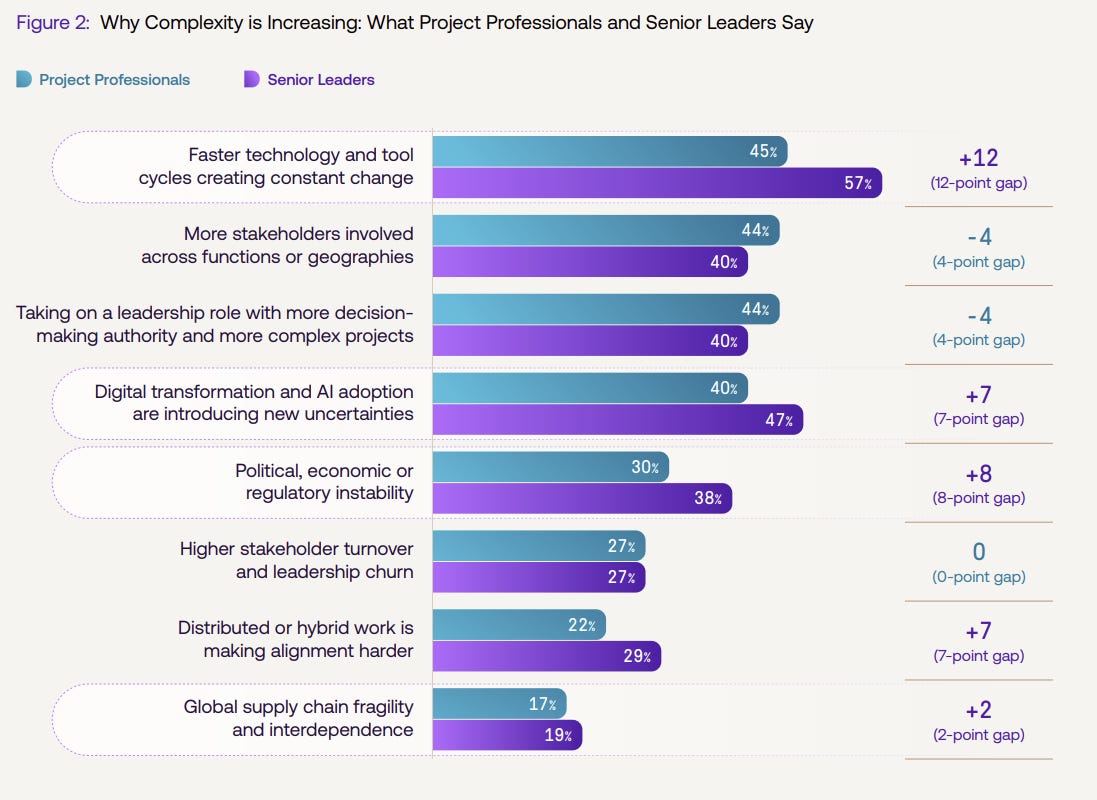
Image credit: Pulse of the Profession® 2026: Driving Success in Complex Projects - Project Management Institute
Being able to see what your senior leader’s perspective might be can shape the conversation differently and hopefully leads to swifter resolution.
Generalist PMs are at a significant advantage in managing complex projects as we are far more likely to use systems thinking as a lens in project management. Only 23% of project professionals identified systems thinking as a critical approach to managing complexity.
A staggering 61% of projects experience an alignment breakdown that reduces value delivered and 9% compromised strategic execution. Every time you are pushed out of a strategy conversation, I want you to stand tall and walk back in with this statistic in hand.
#1 in the list of practices that drive better outcomes: sponsor alignment at initiation. This practice establishes shared understanding of what the project is; who is accountable; and what success looks like (a.k.a. the Project Charter). If you’ve ignored my endless advocacy for this step I hope that this statistic convinces you to bring this consistently into your practice.
Having a PMO only contributed a 5-point difference in recognizing complexity and successfully managing it, suggesting that individual professional practice has a far greater potential to address complexity failures.
Finally, there was some fascinating detail in the Appendix that many readers may have overlooked around project performance. Specifically that aligning with the sponsor during initiation had a 10-point difference between organizations handling complexity and those that did not, meanwhile formal training in project management had only a 3-point gap and scenario planning had no impact. And for all you fans of using AI to teach yourself project management, self-study also had no impact. This suggests that the most important capability a project manager might bring to complex projects is their ability to perceive what is going on and respond to the situation at hand.
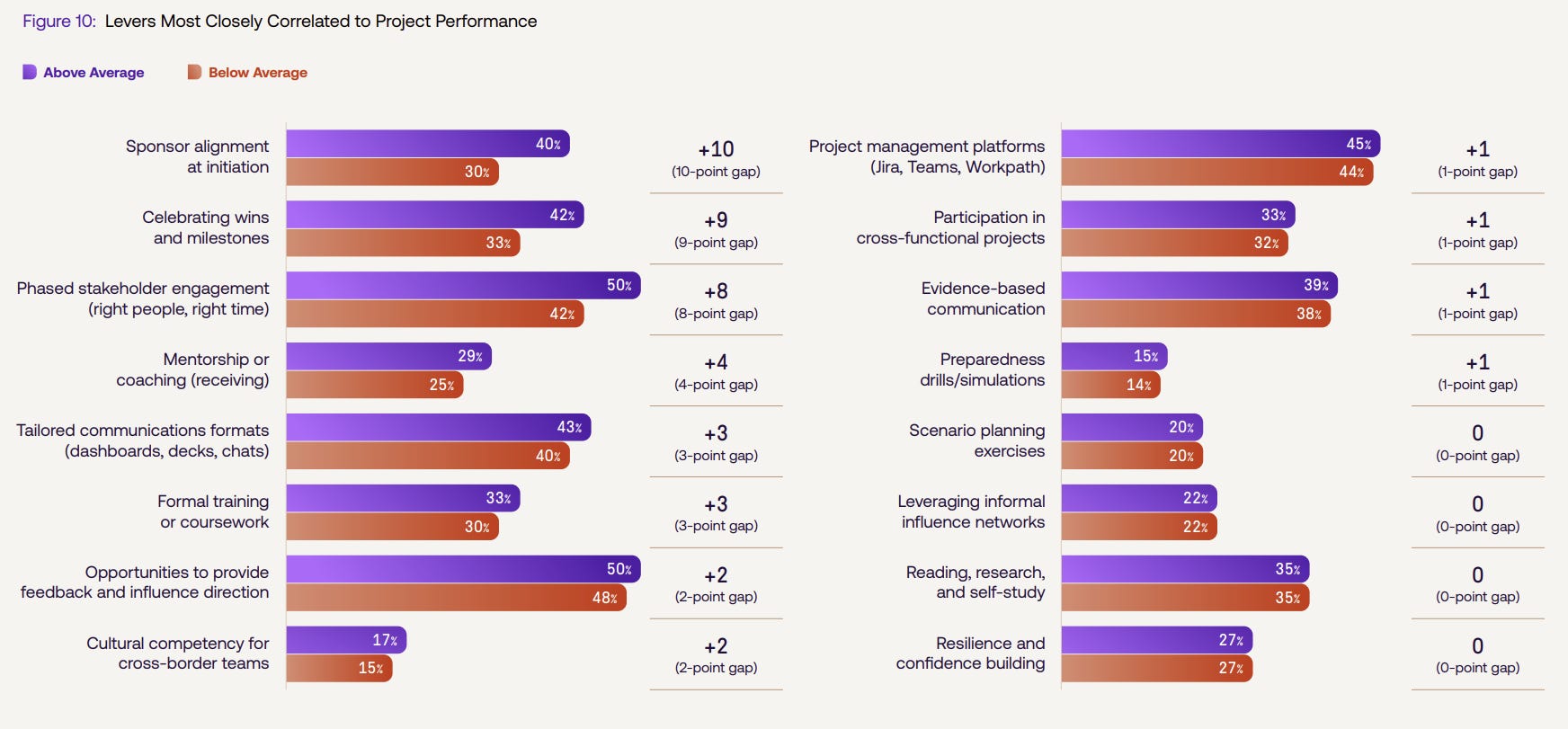
Image credit: Pulse of the Profession® 2026: Driving Success in Complex Projects - Project Management Institute
An interesting read
My inbox has been fascinating this week.
First, a global report from Tempo Software highlighted by Project Management Global finds that mature portfolio management leads to a significantly higher rate of project success (81%) than efforts in less mature organizations (45%).
Second, Antonio Nieto Rodriguez, a project management mind I admire greatly, writes this week’s interesting read illustrating practically for us - with one simple question - exactly why portfolio management is so critical.
…portfolio management is no longer a support function. It becomes the core of strategy execution—and increasingly, strategy itself.
I don’t want to spoil the brilliance of the article by summarizing it here, so I hope you read it!
Your portfolio today determines your revenue tomorrow.
A tip
I’m pretty excited to be giving back to the Generalist World community as a presenter in a few weeks. Generalist World members can register for my session on Value Delivery Maturity taking place June 4, 2026. The workshop will introduce a value-driven mindset, discuss how to build an organization around value delivery, and touch on some strategies to work through the most common anti-patterns blocking value delivery. Register here.
A lesson
If you are running an AI project or digital transformation effort right now I want you to stop and read this piece by Annmarie Curley.
Then I want you to ask yourself, what question is missing in your organization that needs to be asked right now?
Drop it in the comments and let’s see where we are all experiencing a shared struggle.