
May 22, 2026
Volume 04 - Issue 20

This week I’m loving
A great insight from Richard Millington that speaks to a skill many project managers must cultivate in their journey toward more significant leadership roles: persuasive communication.
There has been a lot of chatter about dashboards in recent months. Several popular AI tools on the market are making it easier than ever to generate pretty project data, raising the temptation to use this to justify or endorse project management practices at many organizations.
And those of you who have already done this may have noticed it isn’t working how you expected when it comes to actually getting the endorsement you seek.
Richard helps us understand why.
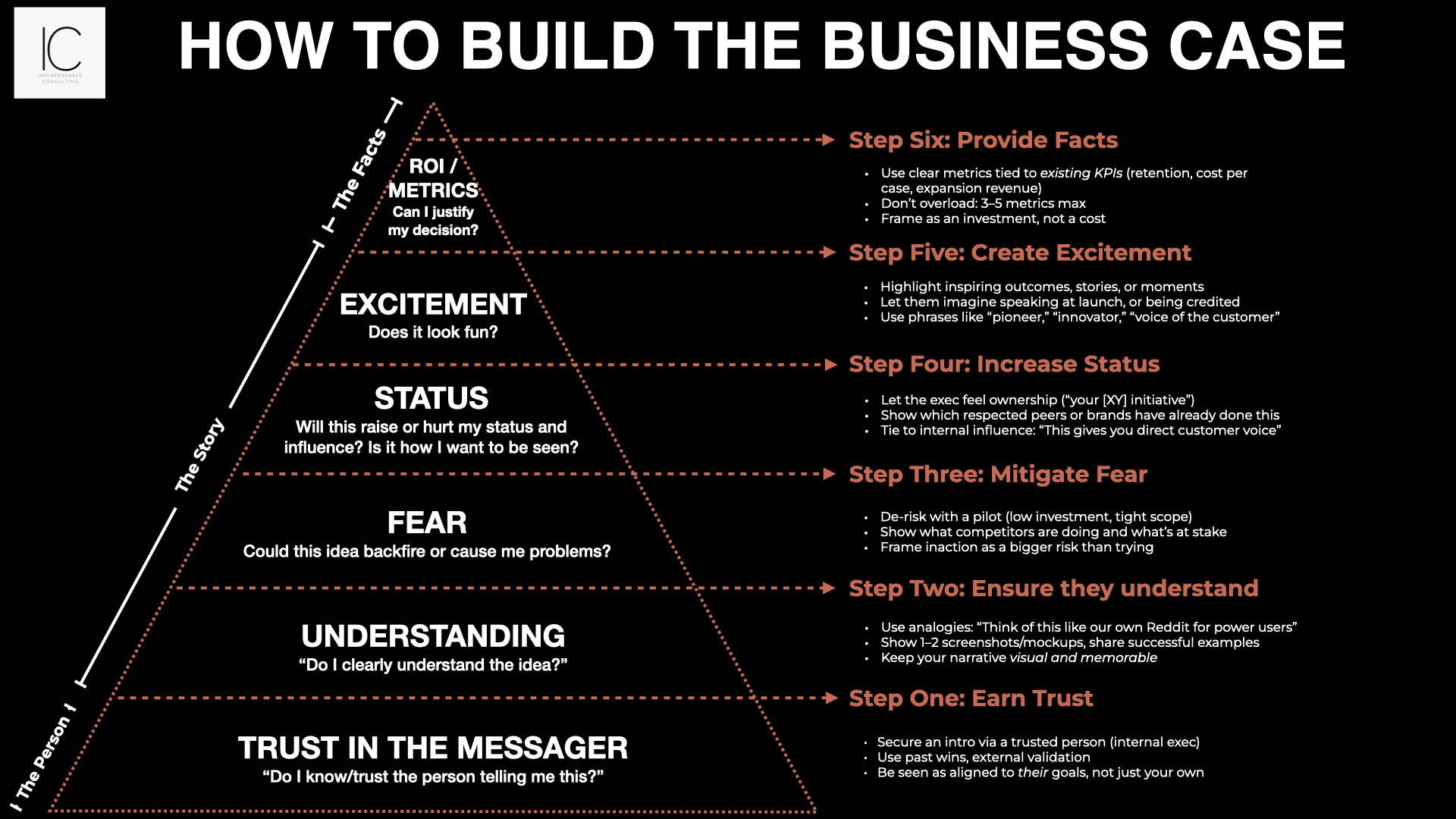
Image credit: Richard Millington - Indispensable Consulting
The truth is that the strongest business case isn’t one that relies on the facts.
Before anyone backs your idea, they are quietly asking:
Do I trust the person bringing me this?
Do I actually understand what it is?
Could this backfire on me?
Will saying yes raise my standing or lower it?
Is this something worth being part of?
Can I point to numbers if someone challenges me?
Answer those in that order and the data slide becomes the last step, not the first.
So the next opportunity you get to present your project or PMO dashboard, resist. Instead focus on your stakeholder emotions, their status, and how to make them feel connected to your work. Invite them to ask the questions and be ready with the facts to support your answers. Building a pretty picture of the data may be faster and easier than ever, but that’s not as useful as it may seem at first.
From the Practice
This week’s “From the Practice segment” highlights another great post from Margareth Fabiola S. Carneiro about the most underestimated skill in project management: communication.
Ineffective communication is the primary contributor to project failure one-third of the time, according to PMI. And yet, 85% of project managers cite stakeholder communication as their biggest ongoing challenge — while only 36% report having structured stakeholder management training.
It should not surprise you to know that communication isn’t just reporting.
Instead, communication builds shared understanding, manages expectations, and creates action.
The project manager who only reports is always reacting. The one who truly communicates is always one step ahead.
There’s a reason why we are encouraged to have a Communication Plan. That plan should articulate with an equally important plan for Stakeholder Engagement. Who cares? How often will they get nervous about what you are doing? What do they need to hear to calm these nerves?
In 2026, the answer is: they care more than ever before; they will get nervous easily; and they need to know a lot to calm down.
What does good communication look like?
It is tailored. That means it reaches the right person, framed the right way.
It hears what isn’t being said and responds to that. This involves strategic listening.
It’s a system, not an event. Plan, review, adjust. Adapt deliberately to what emerges.
Want to learn more about how to become a stronger communicator?
Here’s some amazing people to follow:
Raquel Horta - discusses communication as a key power skill
Amber McMillan - discusses how to communicate authentically and impactfully
Diana Markova - coaches project managers transitioning into people leadership and the communication habits and shifts that come with that journey
Helen Bevan - has incredible visuals and tips for communication particularly around change management
Who would you add to this list?
An interesting read
Aligned with the theme that emerged somewhat in today’s issue, our interesting read this week is from Mike Fisher at Fish Food for Thought on how to turn a dashboard into a story that is believed in.
A.k.a how to communicate a narrative that generates real understanding.
Metrics describe outcomes. Stories explain what outcomes mean and what they demand of us. The gap between those two things is where most leadership communication falls apart.
Mike advocates for a method he calls “The Story Frame”.
As you design your narrative you need to think about three things:
What did we previously believe was true?
What does the data actually show?
What does this mean for how we act?
This approach helps ensure that your audience is recognizing the need to write the next chapter.
The ability to translate metrics into meaning is not a data skill. It is a leadership skill. And like most leadership skills, it is unevenly distributed and consistently underpracticed.
So the next time you are tempted to pop that dashboard up and let it do the talking, I hope you’ll try building a narrative with Mike’s three Story Frame questions, deliver it, and then notice what happens in the room compared to your prior efforts. I don’t think you’ll regret it!
A tip
If you are hoping to brush up on your agile leadership skills there’s a new offering from the folks at Scrum.org. A self-paced course on “Leading Agile Teams” which will dive into the intersection of self-leadership and team leadership alongside leveraging Generative AI in the context of agile teams. The course costs $199USD and is expected to consume about 7 hours of your time.

A lesson
This week I attended a networking session and in one conversation I asked someone how they were enjoying their work at their company. They responded with something I hear often: “I love the culture! Everyone is so nice!”
At first glance, this statement sounds positive. Who wouldn’t like working in a workplace where everyone is “nice”? But, I’m always worried when someone says this. Don’t get me wrong, there’s nothing wrong with kindness and it is a foundational element of strong relationships, but a bridge without supports or tension falls apart. Culture is your bridge to getting things done. The answer I want to hear is “I love the culture! I feel so supported!”
When a culture is focused on “nice” it is inherently promoting silence. And the dangers of silence are significant. This week’s lesson is a cautionary tale on how cultures that focus on “nice” go wrong, at first quietly, and then, explosively.
I want to note, that it took guts for Annmarie Curley to write her article, not every project manager who has experienced a hostile communication talks openly about it, even though virtually all of us have encountered this moment at some point.
She begins her story with a painful scenario many of us have experienced:
I woke up in the UK, five hours ahead of the US, opened my laptop, and read an email that made the floor drop out from under me. It had gone to a group I am part of, a volunteer organization, and it was aimed at me. For the next several hours, while the people who would read it next were still asleep, I sat with it alone.
The truth is that no matter how rational and skilled you may be this moment is governed by biology. But Annmarie points out something we must all remember:
A trigger sets off a stress response, and the psychologist Paul Ekman named what comes next: the refractory period. It is an elongated stress response, a state in which the brain replays the story on a loop, and each replay releases another wave of stress chemicals. That loop does harm in both directions, to the person caught inside it and to everyone within reach of the stress reaction it produces. Inside that state, you are not seeing the situation. You are seeing the version your nervous system keeps selecting for you.
We are taught to pause, not to react in the moment. To let rational thinking resume before we draft our reply.
Then the US woke up. One person read the email and wrote to me privately to say she was shocked, and embarrassed to have received it. One message, and the isolation broke. More than that, it allowed my prefrontal cortex to come back online and to realize that the story I had been telling myself for hours was not true.
The quiet before this moment though, is the part I want you to pay attention to.
…silence is not neutral. To me it read as agreement. To the sender it read as permission. Silence rewards whoever is loudest in the room.
The silence of the sender of the email is just as important to note. And this, is what I want to call out specifically in “nice” cultures. The truth is that we don’t always get along, nor should we. Think about how often you argue with your family. People who are supposed to deeply understand you and tolerate your quirks. It is unlikely that your work colleagues ever get to know you this well. So how could they be less likely to argue with you than your own family? Instead what is happening in a “nice” culture is this behavior:
…carrying an older grievance, a sense of having been wronged that had never been resolved. A grievance held long enough becomes a refractory period that never closes.
And that, is the silence that becomes explosive. The silence whose cost is easy to underestimate. The truth is, that in a “nice” culture, the arrival of the hostility is inevitable.
The damage of a hostile message is rarely contained to the person it targets. It reaches everyone who witnessed it. Under that kind of stress the threat-detection system takes over to protect them, usually well below the level of conscious choice. Some simply go quiet. Others freeze, unable to find words for what they feel. Either way, they step back, contributing a little less and holding their real thinking closer. That withdrawal is rarely temporary, because once a nervous system has learned that a room is unsafe, it does not relax on its own. One hostile exchange can set off consequences that outlast any memory of the message itself, and a group can be left noticeably less stable than the incident alone would seem to explain.
Quietly, the bridge is crumbling, and the work that depends on it is slowly suffering.
What’s the remedy?
You cannot change a pattern you cannot see. The work is learning to notice the narrowing while you are still inside it, so you can pause, recalibrate, and respond on purpose. These are capabilities, not fixed traits, and they can be built.
What I’ve learned is to notice when someone tells me a culture is “nice”. I’ve learned that this likely means behaviors are narrowing. I’ve learned that it is an early signal of culture work that needs to happen to eradicate the quiet silence that risks the entire business.
And when I build teams and companies, I build to hear arguing and to heal from it. To welcome perspectives to be shared openly and to pull grudges out from the closets they are hiding in so that they can be addressed before they start festering. Before the refractory response sets in. Psychological safety is complex. It involves both conscious and unconscious responses. But cultures that succeed must have it and they must be brave enough to insist on practicing it together.