
July 3, 2026
Volume 04 - Issue 26

This week I’m loving wondering
Hello my Generalist PM friends! I hope this week’s note finds you well, and on the downhill ride to December (😱 right! 😱). I have been spending a lot of time thinking about what’s next for this audience as I feel like we should do more than just meet each other in a weekly newsletter. So I’m asking you to tell me what would be valuable to you:
Thanks so much for sharing your perspective!
From the Practice
This week I’m diving into some really valuable advice from Janna Bastow that looks at a particularly dangerous meeting habit: status meetings.
You may know that Janna is a Product leader, rather than a project manager, but in many companies these lines are quite blurred and project managers encounter many of the same challenges that are discussed from a product lens.
Janna opens her discussion with a description of a meeting all project managers have encountered: an “alignment check” where stakeholders are coming together to make sure everyone is on the same page and maybe receive a report of roadmap progress. In projects we know this as a “status meeting”.
Most project managers would agree that this type of meeting should also be known as “scope creep wrangling”. Janna describes this situation in a way that will surely feel familiar:
…a stakeholder says: “Quick thought. Should we move the reporting work up, since two enterprise deals are asking about it?” Someone agrees. Someone else adds a related ask. By the time the call ends, the quarter the team committed to four weeks ago has quietly changed shape. Nobody decided to change it on purpose.
The meeting that was supposed to reduce risk created it.
You may remember Amber McMillan’s advice from a few weeks ago: alignment does not mean agreement. Janna takes this a helpful step further to show that what actually happens is two conversations wearing one calendar invite.
A status conversation is bounded. The other conversation is unbounded. The meeting facilitator is responsible to deliver what should occur. But the meeting facilitator might not realize the unbounded conversation is an agenda, or may invite it simply through how they structure the meeting.
Janna has an incredible visual of these potential two paths:
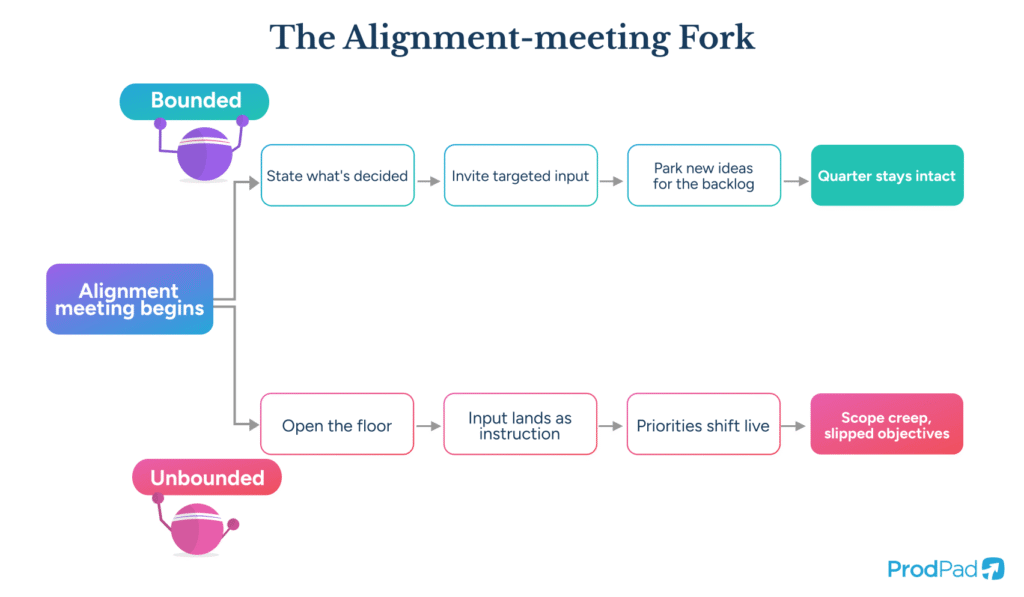
Image credit: ProdPad Blog - Janna Bastow
How do you control this? Three simple steps:
Name what is committed to and state it is not negotiable. The purpose is just to update the status.
If you are seeking input, be explicit about what input you want and why. Open a specific decision for discussion and document a specific outcome.
Rely on your shared documentation. In the case of Products Janna references your roadmap as the tool to maintain alignment. In Projects it is your project charter. Pop it up - remind people what was there - show them the consequences of their ask. And if it is out of scope, add it to the backlog.
The work of running alignment conversations without derailing the quarter happens mostly before the conversation, in the artifacts you bring to it and the boundaries you set at the top.
An interesting read
This week’s interesting read comes from Harvard Business Review courtesy of Irina Wolpert and discusses a problem I think many of you will recognize instantly.
Most companies operate as two organizations: the polished version executives see in dashboards and boardrooms, and the messier, more revealing reality lived by employees.
The polished organization arises unintentionally through the slow accumulation of decisions that summarize reality for a one-up leader. The more layers, the more polish, and the less realistic the picture.
The lived organization isn’t the culture on the wall but the daily interactions and interfaces each individual navigates. This organization is forged in intentional and accidental incentives. As Wolpert puts it: this is human behavior responding to signal.
Artificial intelligence is amplifying this gap.
The board deck is now drafted by an AI assistant working from the function head’s prompt. The function head’s prompt is itself an artifact of what they have learned the executive team wants to hear. The presentation that arrives for the CEO is more coherent and more authoritative than any prior version. Whether it is more accurate is a question almost no one is asking.
And this also means the pressure for a project manager’s reports to conform to this pattern has never been higher. It has always been difficult to tell the truth when a project is off the rails. Now this behavior is risking being an outlier in stark contrast to the compelling polished organization report.
But this is also why project management has never been more important. Cutting through the noise with clarity. Telling the truth even when it is hard. Narrowing the layers between reporting and strategy.
We also need to be sure that we are tapping into genuine information about how things are going and not curated answers already polishing the truth.
How can we be sure?
The same tips shared for a CEO in an organization apply to project managers as well.
What do you see when you examine the story you are told against your project baseline? If these differ, it’s a good clue that the two-organization phenomenon is at work.
Govern the project conscious of the risks of polished and lived versions of the project. Don’t expect that only one exists and don’t manage as though you are only in charge of one.
Build a project team culture that incentivizes people telling the truth, no matter how difficult.
What is your best tip for managing the two organization problem?
A tip
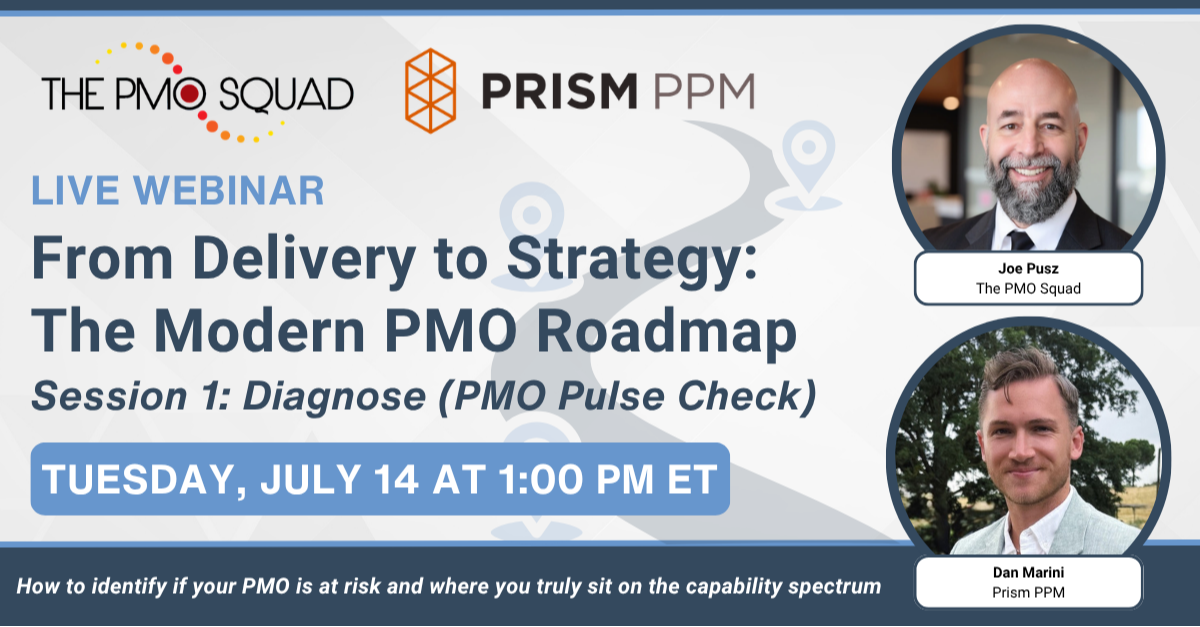
The PMO Squad led by Joe Pusz is putting on a 3-part webinar series focused on how to connect your Project Management Office with organizational strategy. The first session is coming up soon. Register here.
A lesson
If you ask project managers and change managers what they dislike about transformation it is an exciting conversation filled with varied perspectives but usually the reflection contains something like:
Six months on, most of her team had quietly gone back to the old way of working
With at least 90% of AI transformation projects failing to deliver results, in AI rollouts especially right now, this conversation is heated. This week’s lesson, from Annmarie Curley, is a spot on diagnosis that every project and change manager should take note of.
Success or failure is often decided long before the official project has started. Most organizations need to fix this. The fix is getting the project manager involved earlier, when strategic decisions are being made about how the project will unfold.
I loved that this article also calls out something many project managers overlook in the planning of product rollouts: how long the rollout process and support might need to be. We have a tendency to think we just roll the thing out and we’re done. But the truth is that humans take a lot longer to adapt and adopt than this takes into account. Successful rollouts will have an project duration that plans for this.
Finally, I loved that the article calls out that these behaviors aren’t conscious actions. Most people are reacting using parts of their brain that automate our approach to things largely without our awareness. Often during a change process people get blamed for not adapting. This view helps to neutralize that perspective. The article does leave a small gap I think should be filled. Namely, how can you help people feel good about the new thing they need to learn and adopt? If you can make them feel they want to do this, your odds of success go up dramatically. In the Head, Heart, Hands change management method, this is the Heart part.
Have you had a rollout go the way this article describes? If so, what would you change now that you are thinking about this perspective?